
Search our journals and articles

5 / 2025

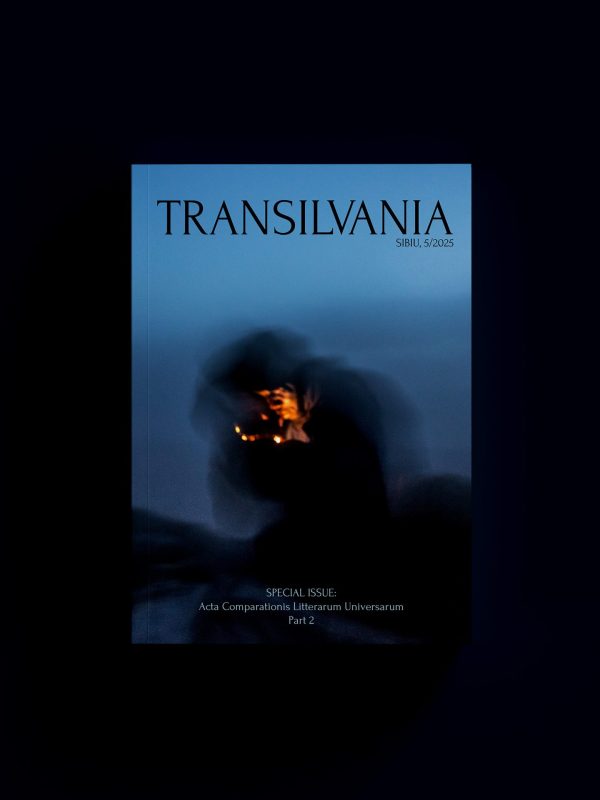
featured Transilvania 5.2025
Revista: 5 / 2025
Anul Publicarii:2025
Print ISSN: Print ISSN 0255-0539; Electronic ISSN 3061-2217

Științe socio-umane

Arte vizuale

Filozofie și studii sociale

Antropologie și etnologie

Sociologie

Științe politice & juridice

Istorie & Antropologie

Studii culturale

Biblioteconomie

Științele limbii

Științele economice

Antropologie. Studii filozofice

Teologie

Studii literare

Autor: Cosmin Borza
Email: cosmi_borza@yahoo.com

Abstract: The article analyzes the work of Grigore Silași (who also signed his name Szilasi Gergely) as a case study to examine the impact of ethnocentric and nationalist ideologies prevalent in Transylvania during the late nineteenth century on the reception of Acta Comparationis Litterarum Universarumʼs program. Silași was the first professor of Romanian language and literature at Cluj/Kolozsvár/Klausenburg University and distinguished himself as a nationalist militant through his social, political, or cultural initiatives, as well as his scholarly contributions on Romanian linguistics, philology, folklore, and literature. Furthermore, he attained the status of “martyr” for the Romanian nation after being dismissed from the university in 1884 due to a Romanian-Hungarian interethnic conflict. Such a multifaceted figure provides a distinctive, albeit often overlooked lens for assessing the prospects and highlighting the limitations of comparative practice in nineteenth century Transylvania. In particular, the article argues that Silașiʼs formulation of a comparative analytical framework aimed to strengthen a peripheral nationalism interested not in local exceptionalism, but in accessing a privileged transnational cultural network that could provide identity legitimacy for a subaltern nation.

Keywords: Grigore Silași, nationalism, inter-imperial comparatism, Acta Comparationis Litterarum Universarum, Transylvanian interethnic conflict.

Acknowledgement: This work was funded by the EU’s NextGenerationEU instrument through the National Recovery and Resilience Plan of Romania—Pillar III-C9-18, through the project A Global History of Romanian Comparatism: A Case Study in Inter-Imperial Comparative Literature (1877–1944), PNRR-III-C9–2023-I8-CF 22/27.07.2023, contract no. 760276/26.03.2024.

Autor: Mihaela Ursa
Email: mihaela.ursa@ubbcluj.ro

Abstract: This article fills the blank space separating two important moments in the transnational and multicultural history of Transylvania. I place in relation Acta Comparationis Litterarum Universarum [Acta] and the Transylvanian School [SA], an early landmark in the establishment of Transylvanian Romanian national culture. While both movements initiate in Transylvania, Acta Comparationis avoids referencing The Transylvanian School, while at same time entertaining the same type of inter-imperial duplicity with regards to the emancipation of the marginal as the Transylvanian School itself does with regards to the emancipation of the Roma. A close analysis of a mock-epic poem by Ioan Budai-Deleanu against the background of the two schools reveals that the inter-imperial position allows a selective plea for nationhood and ethnic dignity while at the time protecting imperial, cultural and socio-political hierarchies and power structures.

Keywords:  inter-imperial, translation, Acta Comparationis Litterarum Universarum, Școala Ardeleană (The Transylvanian School), Țiganiada (The Gypsiad), Ioan Budai-Deleanu

Acknowledgement: This work was funded by the EU’s NextGenerationEU instrument through the National Recovery and Resilience Plan of Romania—Pillar III-C9-18, through the project A Global History of Romanian Comparatism: A Case Study in Inter-Imperial Comparative Literature (1877-1944), PNRR-III-C9-2023-I8-CF 22/ 27.07.2023, contract no. 760276/ 26.03.2024.

Autor: Rareș Moldovan
Email: rares.moldovan@ubbcluj.ro

Abstract: The article begins by enquiring what the project of redescribing the history of a phenomenon such as Romanian comparatism entails theoretically. I provide a brief operational sketch based on two axes, the historical/hermeneutical and the memorial/auratic. I propose the image of a two-fold spectrality for the key figures analyzed, Hugo Meltzl and Titu Maiorescu: theoretical specters that can be identified within their texts and the haunting spectrality of their possible or repeated return. The article offers comparative/contrasting readings of two significant texts, Meltzl’s “Vorläufige Aufgaben der vergleichenden Litteratur” [Preliminary Tasks of Comparative Literature] (1887-1878) and Maiorescu’s “Literatura română și străinătatea” [Romanian Literature Abroad] (1882), showcasing their distinct visions of comparatism.

Keywords: Comparatism, world-literature, modernity, Hugo Meltzl, Titu Maiorescu

Acknowledgement: This work was funded by the EU’s NextGenerationEU instrument through the National Recovery and Resilience Plan of Romania—Pillar III-C9-18, through the project A Global History of Romanian Comparatism: A Case Study in Inter-Imperial Comparative Literature (1877-1944), PNRR-III-C9-2023-I8-CF 22/ 27.07.2023, contract no. 760276/ 26.03.2024.

Autor: Mircea Minică
Email: mirceaminica@gmail.com

Abstract: The starting point of this article is the ambivalence of Hugo Meltzl’s position: while he establishes a broad principle of polyglottism for Acta Comparationis Litterarum Universarum, he ultimately selects only ten working languages for the journal—specifically, ten European languages that he considers capable of producing major literatures. Building on this linguistic hierarchy, I aim to examine how historical and comparative linguistics in nineteenth-century Europe not only classified languages but also ranked them. I explore the criteria underpinning these hierarchies, the arguments used to justify them, as well as their occasional contestation and eventual abandonment in the latter half of the century with the rise of Neogrammarian approaches in linguistics. In the final section, I assess the extent to which the dominant linguistic hierarchies in historical and comparative linguistics remain relevant to the decaglot canon advocated by Meltzl.

Keywords: polyglottism, decaglottism, linguistic hierarchy, historical and comparative linguistics.

Acknowledgement: This work was funded by the EU’s NextGenerationEU instrument through the National Recovery and Resilience Plan of Romania—Pillar III-C9-18, through the project A Global History of Romanian Comparatism: A Case Study in Inter-Imperial Comparative Literature (1877-1944), PNRR-III-C9-2023-I8-CF 22/ 27.07.2023, contract no. 760276/ 26.03.2024.

Autor: Mihnea Bâlici
Email: mihnea.balici@ubbcluj.ro

Abstract: The establishment of Acta Comparationis Litterarum Universarum (1877–1888) in Kolozsvár/Klausenburg/Cluj represents a key moment in the history of comparative literature, shaped by nineteenth century technological progress and the political fallout from the 1848 nationalist movements. This article traces the transnational mobilities of Acta’s two central figures, Hugo Meltzl and Dora d’Istria, and their impact on the journal’s vision of Weltliteratur and its polyglot ideals. While Acta sought to protect national literatures and linguistic identities, these authors’ projects remained paradoxically tied to inter-imperial frameworks. Using a materialist lens attentive to the class dimensions of their travels, the article argues that Meltzl and Dora d’Istria’s mobility shaped their comparative methods and ideological stances, revealing a tension between internationalist aspirations and pragmatic solutions that reinforced nationalist biases. 

Key-words: Hugo Meltzl, Dora d’Istria, mobility studies, comparative literature, nationalism, Acta Comparationis Litterarum Universarum

Acknowledgement: This work was funded by the EU’s NextGenerationEU instrument through the National Recovery and Resilience Plan of Romania—Pillar III-C9-18, through the project A Global History of Romanian Comparatism: A Case Study in Inter-Imperial Comparative Literature (1877-1944), PNRR-III-C9-2023-I8-CF 22/ 27.07.2023, contract no. 760276/ 26.03.2024.

The author wishes to thank Erika Mihalycsa for the revision of the texts translated from Hungarian to English.

Autor: Teona Farmatu
Email: teona.farmatu@ubbcluj.ro

Abstract: This article explores the intricate relationship between the pre-institutional phase of comparative literature and the ongoing international debate about copyright in late of nineteenth century. It examines how comparative literature as a discipline in the making has navigated the complexities of copyright and how the evolving institution of copyright has, in turn, influenced the development of literary comparatism. Specifically, the article frames the contrasting views of Hugo Meltzl and Victor Hugo regarding the evolution of comparative literature and literary protectionism, focusing on the positions expressed at the 1878 Parisian Congress. Meltzl denounces the commodification of literature in a capitalist society, particularly through literary fairs and book exhibitions, and advocates for a return to a more classical, anti-materialist approach. In turn, Hugo’s perspective reflects the authoritarian, Gallo-centric viewpoint Meltzl criticized. Despite their differences, both thinkers share a commitment to the concept of literary genius. Finally, the establishment of universal copyright serves as an uncomfortable and even threatening indicator of the fundamental principles and missions that comparative literature, as an evolving discipline, has confronted.


Keywords: international copyright, comparative literature, World Literature, Acta Comparationis Litterarum Universarum, Hugo Meltzl, Victor Hugo, International Literary Congress, Paris, literary protectionism.


Acknowledgement: This work was funded by the EU’s NextGenerationEU instrument through the National Recovery and Resilience Plan of Romania—Pillar III-C9-18, through the project A Global History of Romanian Comparatism: A Case Study in Inter-Imperial Comparative Literature (1877-1944), PNRR-III-C9-2023-I8-CF 22/ 27.07.2023, contract no. 760276/ 26.03.2024.

The author wishes to thank Erika Mihalycsa for the revision of the texts translated from Hungarian to English.

Autor: Letitia Guran
Email: lguran@email.unc.edu

Abstract: This essay discusses Acta Comparationis Litterarum Universarum’s program of global comparatism by considering its three programmatic texts, which include Hugo Meltzl’s notes on “decaglottism,” a concept that  undermines the initial polyglot, anti-imperial spirit of the journal. Within the context of nineteenth century Transylvania, which practiced what Anca Parvulescu and Manuela Boatcă call “interglottism,” Acta was geared both against methodological nationalism and the hegemonic perspective of great-powers model in comparative studies. Foreshadowing what David Damrosch calls a true “rebirth of the discipline” of comparative literature in the post-theory age, Acta stimulates fertile, unexpected alliances with contemporary scholars of créolité, translation, and comparative studies, unveiling new paradigms of planetary relationality. In the wake of comparative scholarly work by Gayatri Chakravorty Spivak, Emily Apter, Mary Louise Pratt, and Christian Moraru, this article considers the praxis of “translation as reparation” and “gift,” as a mode of fostering a “planetary” approach to comparatism by favoring translation from cultures which for centuries have existed outside canonical circuits of exchange promoted by dominant cultures.   

Keywords: polyglottism, decaglottism, interglottism, planetary translation, créolité, inter-imperial translingualism, planetary.

Autor: Shu-mei Shih
Email: shih@humnet.ucla.edu

Abstract: The article builds on the contributions of this special issue in order to point to the racial, linguistic, and epistemic hierarchies embedded in Acta Comparationis Litterarum Universarum. The discussion is situated within the broader genealogy of European humanism and its foundational dichotomy between humanitas and anthropos. In dialogue with Sylvia Winter, Nishitani Osamu, and Naoki Sakai Shih emphasizes the journalʾs reproduction of colonial and racialized distinctions between so-called civilized and primitive cultures. Of particular interest to the author of the “Afterword” is the journal’s ambiguous engagement with subaltern cultures of the Austro-Hungarian Empire – Romanian and Romani literature.

Keywords: comparative literature, Acta Comparationis, humanitas and anthropos, subaltern cultures.

Acknowledgement: This work was funded by the EU’s NextGenerationEU instrument through the National Recovery and Resilience Plan of Romania—Pillar III-C9–18, through the project A Global History of Romanian Comparatism: A Case Study in Inter-Imperial Comparative Literature (1877–1944), PNRR-III-C9–2023-I8-CF 22/27.07.2023, contract no. 760276/26.03.2024.

Științe vizuale

Dosar

Istorie si studii culturale

Istorie

Științele educației

Filozofie și studii politice

Stiintele comunicarii

Etnografie si folclor

Fizica speculativa

Recenzii

Economie

Artele spectacolului

Eveniment