Search our journals and articles

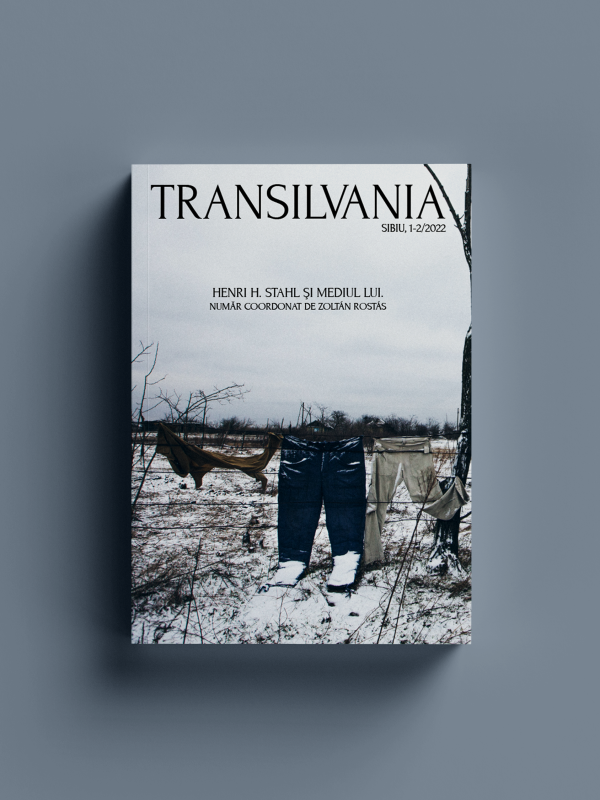
nr. 1-2 / 2022

Transilvania 1-2.2022 Featured
Revista: 1-2 / 2022
Anul Publicarii:2022
Print ISSN: 0255-0539

Științe socio-umane

Arte vizuale

Filozofie și studii sociale

Antropologie și etnologie

Autor: Zoltán ROSTÁS
Email: zoltan.z.rostas@gmail.com

Henri H. Stahl and His Milieu

Abstract: In this introductory article, it is emphasized that Professor Henri H. Stahl’s birthday is an opportunity to deepen the knowledge of his work and to identify new ways of researching unclear periods. An innovator in both village research and its social history, Henri H. Stahl became well known in the international scholalrly circles too. Research into his work, activity and environment should not only be an act of respect, but a contribution to the modernization of the social sciences.

Keywords: Henri H. Stahl, sociological monographs, Dimitrie Gusti, social intervention, sociology of history, sociology in the communist regime.

Citation suggestion: Rostás, Zoltán. „Henri H. Stahl și mediul lui”. Transilvania, no. 1-2 (2022): 1-4.

https://doi.org/10.51391/trva.2022.01-02.01.

Autor: Ionuț BUTOI
Email: ionut.butoi@cooperativag.ro

Rereading Stahl

Abstract: In this paper, I highlight mostly ignored aspects of the work of H. H. Stahl: his stance on the issue of “national specificity,” on village culture, and on the modernization of Romanian villages through “culturalization”. Reviewing some of his popularization and scientific texts from the 1930, but also his late contributions from the 1980, show a remarkable continuity and consistency of Stahl’s vision on these subjects. And it is not the kind of vision someone would expect from a socialist or Marxist social scientist. For Stahl, the village culture was the true (and unique) Romanian culture, a peasant culture that he was very fond of. In some respects, and, in fact, not so surprisingly, Stahl, what regards “national specificity” and village culture, is much closer to (the reactionary, traditionalist, autochthonous) Mircea Vulcănescu, his monographist fellow and personal friend, than any other leftist thinker in interwar Romania.

Keywords: Henri H. Stahl, village culture, sămănătorism, monographic research.

Citation suggestion: Butoi, Ionuț. „Recitindu-l pe Stahl”. Transilvania, no. 1-2 (2022): 5-14.

https://doi.org/10.51391/trva.2022.01-02.02.

Autor: Ioana-Ruxandra FRUNTELATĂ
Email: ioana.fruntelata@litere.unibuc.ro

Revisiting Henri H. Stahl’s View on “True and False Village Culture”

Abstract: This article sets into light the context of ideas and relevant biographical circumstances at the time when the Romanian sociologist Henri H. Stahl issued the leaflet Cultura satelor. Cum trebue înțeleasă [The Village Culture. How It Should Be Understood] (1934), in a period of crisis of the Sociological School of Bucharest, when the project of its founder, Dimitrie Gusti, to employ the results of the monographic research campaigns in order to initiate a social reform, seemed to have reached a dead point. At the same time, we pay attention to the cultural distinctions and relations (rural and urban culture, popular/ folk and literate culture) that Stahl debates in his text on village culture. Taking into account the fact that each new reading of a scientific work implicitly updates its content, we also find in the pages written by Henri H. Stahl in 1934 an interesting material for revisiting engaged anthropology, a direction of study developed in the U.S.A. in the late 1970s but rooted in an older model of addressing anthropological research which was created during the Second World War and anticipated as early as the end of the nineteenth century. Beyond different labels applied to research tendencies in social sciences or ethnological/ anthropological approaches in various epochs, we argue that the manner in which researchers influence (more or less intentional) their target-communities not only challenges professional ethics but also provokes a meaningful reflection on the values which are ‘at stake’ in any intercultural encounter.

Keywords: Henri H. Stahl, The Sociological School of Bucharest, Village Culture vs Urban Culture, True vs False Culture, Genuine vs Spurious Culture, Cultural Action, Engaged Anthropology.

Citation suggestion: Fruntelată, Ioana-Ruxandra. „O rediscutare a viziunii lui Henri. H. Stahl despre „adevărata și falsa cultură sătească”. Transilvania, no. 1-2 (2022): 15-24.

https://doi.org/10.51391/trva.2022.01-02.03.

Autor: Ioana REPCIUC
Email: irepciuc@gmail.com

The Rolling Mill of Observation: The Research Technique According to Henri H. Stahl

Abstract: The paper presents the book of Henri H. Stahl, The Technique of the Sociological Monograph (1934) and delineates the author’s main achievements within the fieldwork methodology from the point of view of Romanian ethnology and folklore studies. As an important member of the interwar sociological school of Bucharest led by D. Gusti, Stahl was thoroughly interested in developing a comprehensive research methodology ready to be applied by the new members of the large research teams of the monographic campaigns. His method includes the attention devoted to getting in touch with the life of the village and the peasants while building psychological trust and empathy between interviewer and interviewee; this complex protocol of accommodation proves to be one of the first and the most sympathetic strategy in the history of anthropological fieldwork. Another aspect of primary interest in Stahl’s methodology is the fact it is drafted simultaneously with the development of peasant studies and rural sociology in the U.S., and the challenges that western anthropology faces in having to adapt its methods to studying peasant societies. Though Stahl often opposes in his studies the sociological school and the Romanian folklore studies, his contribution to Romanian folklore research was undoubtedly acknowledged and appreciated.

Keywords: Henri H. Stahl, the Sociological School of Dimitrie Gusti, fieldwork methodology, social anthropology, folklore, peasant studies.

Citation suggestion: Repciuc, Ioana. „Laminorul observației. Tehnica cercetării de teren în concepția lui Henri H. Stahl”. Transilvania, no. 1-2 (2022): 25-32.

https://doi.org/10.51391/trva.2022.01-02.04.

Autor: Cristian VASILE
Email: cristivasile2002@yahoo.com

Biografia și opera lui Henri H. Stahl reflectate în dosarul său de cadre

Abstract: This paper discusses the content of the cadre file of Henri H. Stahl preserved in the Archives of the University of Bucharest’s Rectorate. In the form in which it has been preserved after 1989, the personnel file of H.H. Stahl seems, from several points of view, atypical. If we compare it with the cadre files of the 1950s, it surprises by the apparent “goodwill” of the communist cadres towards H.H. Stahl. This ideological solicitude is manifested in the interpretation given to main cultural and political events in H.H. Stahl’s life. In other circumstances such political past could be labeled as unusable in a communist context. Equally curious and noteworthy is the issue of the ethnic origin attributed (and not necessarily real or assumed by the one described in the file), more precisely the issue of Stahl’s nationality (Jewish) which was recorded in the file. Analyzing Stahl cadre file we can wonder if the integrity of this dossier has not been compromised by removing, extracting or modifying documents by the personel staff services or by someone else.

Keywords: Henri H. Stahl, cadre file, communism, Department of Sociology, University of Bucharest.

Citation suggestion: Vasile, Cristian. „Biografia și opera lui Henri H. Stahl reflectate în dosarul său de cadre”. Transilvania, no. 1-2 (2022): 33-38.

https://doi.org/10.51391/trva.2022.01-02.05.

Autor: Alina JURAVLE
Email: alina.juravle@gmail.com

Henri H. Stahl and the Agricultural Communes in 1942 – A Foray into the Issue of Modernizing Romanian Agriculture

Abstract: The following study is an attempt to analyze a series of articles – or a five part commentary – that Henri H. Stahl publishes in the Romanian newspaper Timpul, in June and July 1942. His texts deal with a policy aiming to promote the creation of agricultural communes, a form of cooperative organizations designed to help peasants buy modern agricultural machinery, receive state guidance, increase agricultural productivity, and thus meet the needs of the market and the state. Our finds suggest that the articles are part of a public campaign and dialogue, regarding the problems of Romanian agriculture – and their solutions. Stahl carries a deep knowledge of the underlying breadth and history of the issues he discusses and a consciousness of his position – on the side of the peasantry and of the community development methods the Royal Foundation’s Teams had promoted.

Keywords: Henri H. Stahl, 1942, agricultural communes, peasants, agricultural policy, rural development, agricultural machinery, modernization, Aurelian Pană.

Citation suggestion: Juravle, Alina. „Henri H. Stahl și obștile agricole în 1942 – o incursiune în problematica modernizării agriculturii românești” Transilvania, no. 1-2 (2022): 39-54.

https://doi.org/10.51391/trva.2022.01-02.06.

Autor: Cristian PREDA
Email: cristian.preda@unibuc.ro

Henri H. Stahl’s Student: Matei Dogan in 1945-1946

Abstract: The paper uses letters – some unpublished – from the mid-1940s and the second half of the 1970s exchanged by Mattei Dogan and Henri H. Stahl, to render the way sociological education was organized at the University of Bucharest immediately after the Second World War.

Keywords: comparative politics, sociology, social ecology, College for Jewish students, University of Bucharest, social-democracy, antisemitism.

Citation suggestion: Preda, Cristian. „Un student al lui Henri H Stahl: Matei Dogan în 1945-1946”. Transilvania, no. 1-2 (2022): 55–58.

https://doi.org/10.51391/trva.2022.01-02.07.

Autor: Dumitru SANDU
Email: dumitru.sandu@gmail.com

Central Values in Communities of Practice for Rcientific Research at H.H. Stahl

Abstract:I This short presentation is about the communities of research practice facilitated by Professor Henri H. Stahl (HHS). Own experience of being a student, doctoral student, and young researcher under the mentorship of HHS served as a ground for reconstructing the style of HHS as a facilitator of communities of research practice. The space of Stahl’s communities of research practice was structured in a three-dimensional way. He acted to form his students and collaborators to value the definition and operationalization of working concepts, use of qualitative-quantitative mixed methods, and open communication with all the partners of the scientific research. The roots of this style of facilitating research communities of practice were in Stahl’s practice of monographic research, in his multidisciplinary social research and, also, in key references to the methodological Western literature that he studied and followed.

Keywords: communities of practice, mixed methods, place contextualization, operationalization of concepts, academic integrity.

Citation suggestion: Sandu, Dumitru. „Valori centrale în comunități de practică a cercetării științifice la H.H. Stahl”. Transilvania, no. 1-2 (2022): 59-64.

https://doi.org/10.51391/trva.2022.01-02.08.

Autor: Theodora-Eliza VĂCĂRESCU
Email: theoeliza@yahoo.com

Suave beings, amazons, tender mothers, agreeable dabblers…

Women in Rural Interventionism: Romania, 1935–1939

Abstract: Between 1934 and 1939, several hundred voluntary student teams went to Romanian villages to perform “cultural work,” i.e., to help and guide peasants to work more productively and to live healthier lives. In 1938, the Law of the Social Service was passed, stipulating that all university graduates, irrespective of gender and academic specialization, were required to take part in social intervention activities in villages to obtain their diplomas. In this paper, I argue that a new constellation of gender ideas, norms and expectations was drawn up in order to allow for enough room for young middle-class women to be part of student teams that were going to spend a couple of months away from their families and in the unknown settings of the rural areas. Therefore, I explore the discourses used in the main information and propaganda periodical published by the Social Service and I identify and illustrate some strategies and mechanisms employed in the production of the gender model needed for the social and national construction of the new and improved Romanian village.

Keywords: women’s history; interwar Romania; Dimitrie Gusti; gender configurations; social interventionism.

Citation suggestion: Văcărescu, Theodora-Eliza. „Suave făpturi, cerbere, blânde mume, diletante agreabile, vivandiere…Femeile în publicațiile periodice ale Serviciului Social, România 1935–1939”. Transilvania, no. 1-2 (2022): 65-79.

https://doi.org/10.51391/trva.2022.01-02.09.

Autor: Marian COMAN
Email: marian.coman@istorie.unibuc.ro

The Sociologist and the Historians: Henri H. Stahl on Romanian Historiography

Abstract: The article focuses on a case-study of a scientific dialogue (or lack of it) between the Marxist sociologist Henri H. Stahl and Romanian historians. The first section of the study, A failed dialogue, examines the various rhetorical strategies used by Henri H. Stahl when addressing an audience of historians. Stahl’s increasingly irritated tone, triggered by what he perceived to be his marginalization by professional historians, seems only partially justified. The reception of Stahl’s studies of historical sociology was heterogeneous, but despite some positive reviews his contributions remained rather overlooked in the field of historiography. The second section of the article, The taxonomy of Romanian historiography, looks at the historians through the lenses of Stahl’s scientific references and late life interviews. Apart from Iorga, to whom Stahl was emotionally and intellectually attached, the sociologist classified Romanian historians in four categories: (1) respected, but out dated; (2) meticulous, but rather thick; (3) pseudo-socialising and dangerous; (4) useful and trans-disciplinary. In the end, Stahl’s growing frustration with Romanian historiography seems to be best explained by his failure to initiate a methodological revolution in the field.

Keywords: historiography; sociology; inter-disciplinary; Henri H. Stahl; methodology.

Citation suggestion: Coman, Marian. „Sociologul și istoricii. Henri H. Stahl despre istoriografia română”. Transilvania, no. 1-2 (2022): 80-90.

https://doi.org/10.51391/trva.2022.01-02.10.

Autor: Dana COSTIN
Email: dana.costin1@yahoo.com

The Written and Narrated Memories of Henri H. Stahl

Abstract: This paper aims to address the written and narrated memories of Henri H. Stahl who left behind two memorial works: Memories and Thoughts from the Old School of “Sociological Monographs”, published in 1981, and the collection of interviews from 1985-1987, which appeared in 2000, under the title Monography as Utopia. Although they were conceived only a few years apart, the two forms of memoirs show some significant differences. In the following study, I will present the specifics of each of them, in order to later propose a brief comparative analysis of the two texts.

Keywords: Henri H. Stahl, memoirs, oral history, social history, monography, communism, sociological research, Dimitrie Gusti.

Citation suggestion: Costin, Dana. „Amintirile scrise și povestite ale lui Henri H. Stahl”. Transilvania, no. 1-2 (2022): 91-96.

https://doi.org/10.51391/trva.2022.01-02.11.

Autor: Henri H. Stahl

Republicăm două texte din anul 1939, semnate de Henri H. Stahl. Ambele au apărut în periodicul Curierul Serviciului Social, editat de Fundația Culturală „Principele Carol” și adresat, în primul rând, absolvenților și absolventelor de studii superioare care urmau să participe la „munca de ridicare a satelor” prevăzută în Legea Serviciului Social din 1938. Inițial, publicația apărută în 1934 se numea Curierul Echipelor Studențești, avea o circulație și un format mai mici și se adresa echipelor voluntare regale, care efectuau stagii de cercetare sumară și intervenție socială în satele de pe teritoriul României. Între 1935 și 1938, odată cu extinderea participării tinerelor și tinerilor la acest tip de „acțiune socială”, revista a crescut în conținut și acoperire, iar în 1939, după promulgarea Legii Serviciului Social, s-a transformat în Curierul Serviciului Social, una dintre primele și cele mai substanțiale reviste de cultură organizațională și propagandă din România interbelică1. Henri H. Stahl, împreună cu Octavian Neamțu, a fost redactor la Curierul Echipelor Studențești, unde a publicat numeroase articole în perioada 1935–1938. Din 1939 s-a implicat mult mai puțin în realizarea revistei, singurele texte pe care le-am găsit fiind cele pe care le redăm în acest număr. Primul este o prelegere susținută la o școală de comandante ale Serviciului Social – viitoarele echipe de absolvente care mergeau în sate urmau să fie conduse de o tânără care făcuse acest tip de instrucție, asemenea colegilor bărbați. Al doilea articol este o scurtă descriere a expoziției internaționale cu tema „Muncă și voie bună”, organizată de Serviciul Social în cadrul Muzeului Satului. În aceste texte, Stahl prezintă pe scurt viziunea asupra stării populației rurale din România și concepția Serviciului Social cu privire la felul în care echipele S. S. – în acest caz, mai ales absolventele de studii superioare – sunt datoare să contribuie la „ridicarea culturală a satelor”, prin concentrarea asupra a trei dimensiuni, pe care le discută și explicitează: capitolul sănătății, capitolul muncii, capitolul culturii intelectuale și morale.

Autor: Rucsandra POP
Email: rucsandra.pop@gmail.com

“We know very little about the village”

Abstract: In this article, I look at Mihai Pop as an agent of continuity, but also as an agent of theoretical refreshment in the social sciences in communist Romania. Through his research activity, but also through his status as director of the Institute of Folklore and university professor, he ensured not only the connection with the past, but also a permanent connection of the local scientific field with research centers around the world. I have chosen to stop at some pivotal moments in the history of ethnology during the communist period that have Pop as the protagonist, whether it is theoretical disputes, the practice of discipline or the evolution of institutions. I want to show both the way in which the study of folklore was distorted by the ideology, but also the strategies by which the scientific field maintained, as far as the times allowed, a kind of autonomy. I will start from Mihai Pop’s vision of the village and of the folkloric reality showing that, despite the passing of the years, the changes in the political regime and the evolution of the social sciences, the researcher’s vision on the Romanian village has not changed fundamentally during his career. I will then show how the theoretical dispute between Mihai Pop and George Călinescu, from the early 1960s, imposed a new conception of the notion of literary folklore as an ethnological science and not a philological one. I will also point out how Mihai Pop’s double role – as director of the Folklore Institute and Folklore professor at the University of Bucharest greatly influenced the development of the field during communism.

Keywords: Mihai Pop, village, ethnology, communism, The Institute of Folklore, G. Călinescu.

Citation suggestion: Pop, Rucsandra. Nu știm decât foarte puțin ce este satul”. Transilvania, no. 1-2 (2022): 103-110.

https://doi.org/10.51391/trva.2022.01-02.13.

Autor: Zoltán ROSTÁS
Email: zoltan.z.rostas@gmail.com

Henri H. Stahl: A Sociologist Building History.

The Perspective of a Historian from Budapest

Abstract: The purpose of this review is to present an anthology – published in Hungarian – of significant excerpts from the work of Henri H. Stahl. This anthology was edited by the Budapest historian Ambrus Miskolczy, and is the fourth of its kind, after the ones in France, Italy, and the United States. After recalling the influence of the historian Nicolae Iorga and of the social democratic ideology on the young Henri H. Stahl, another decisive impact on Stahl was the rural sociological research led by Dimitrie Gusti, as illustrated in the fragments chosen to be included in the book. The review provides more space to Stahl’s original theory of exploring the past from the present towards the past. This approach to historical sociology led Stahl to the conclusion that the Romanian Middle Ages differed significantly from the same period in the West. The anthology also contains articles against unscientific positions, which were current in the 1930s and 1980s. The anthology itself and its introductory study – published in 1992 – remain valid to this day.

Keywords: historical sociology; monographic sociology; social archeology; rural history; Henri H. Stahl; Nicolae Iorga; Dimitrie Gusti; Ambrus Miskolczy.

Citation suggestion: Rostás, Zoltán. „Henri H. Stahl – un sociolog constructor de istorie. Perspectiva unui istoric budapestan” Transilvania, no. 1-2 (2022): 111-118.

https://doi.org/10.51391/trva.2022.01-02.14.

Autor: Maria LARIONESCU
Email: maria.larionescu@gmail.com

REVIEW: Zoltán Rostás, Theodora-Eliza Văcărescu, eds. In honorem SANDA GOLOPENȚIA

Abstract: This volume is a surprise-gift offered by the informal research and debate group coordinated by Professor Zoltán Rostás, dedicated to Sanda Golopenția. A prestigious researcher, she is the daughter of the well-known sociologist Anton Golopenția, member of the Bucharest Sociological School. The volume brings together fifty-one studies, pieces of research, archive notes, essays, letters, prose, poems, which the editors have gathered from valued members of the global academic community, with whom Sanda Golopenția has exchanged messages. In this comment I have chosen to focus on several of the diverse interests and passions of Sanda Golopenția (S.G.). She brought significant contributions to linguistics, ethnography, semiotics, theater, sociology, and social history, among others. Among these, I will discuss selected aspects that are highly relevant to the Sociological School of Bucharest and to the activity of her parents, Anton Golopenția and Ștefania Cristescu- Golopenția, as also highlighted by the study authors. This short list includes: 1) A comprehensive profile of Sanda Golopenția’s life and career, which sheds light on the history of the Bucharest Sociological School; 2) “The Epistolary Rhapsody” – a benchmark achievement within the frame of modern historiography; 3) The reconstruction of a major chapter in the history of sociology, serving as a window towards a “total editorial fact”; 4) The project of interventionist sociology, comprised in the student campaigns of the Social Service in Romanian villages, aiming for the emancipation of the peasantry, which was also a strategic component in the national mass-media of that time; 5) Sanda Golopenția’s personality, serving as an inspirational model for young and aspiring intellectuals.

Keywords: Dimitrie Gusti, Bucharest Sociological School, Anton Golopenția, Sanda Golopenția, Ștefania Cristescu Golopenția, monographical teams, Royal student teams, action-research, the peasant issue, cultural action, The Gusti Cooperative.

Citation suggestion: Larionescu, Maria. „REVIEW: Zoltán Rostás, Theodora-Eliza Văcărescu, eds. In honorem SANDA GOLOPENȚIA”. Transilvania, no. 1-2 (2022): 119-124.

https://doi.org/10.51391/trva.2022.01-02.15.

Autor: Antonio MOMOC
Email: antonio.momoc@fjsc.ro

REVIEW: Zoltán Rostás, Scrisori inedite adresate lui Dimitrie Gusti

Abstract: The volume “Unprecedented letters addressed to Dimitrie Gusti” captures the world of the interwar Romanian village and episodes from the daily life of the monographers in 40 unpublished letters. It includes an introduction, notes and comments signed by sociologist Zoltán Rostás. The first part comprises the letters addressed by the villagers from Drăguș to Gusti between 1929-1954, while the second part reveals 26 letters sent by Traian Herseni between 1927-1942 to his mentor, the sociologist Dimitrie Gusti. The volume ends with 8 letters sent by other foreign disciples and researchers to the founder of the Sociological School in Bucharest. The letters reveal uknown facts about the inner organisational conflicts within the Monograhy School.

ligobet

Keywords: Sociological School of Bucharest, social history, alternative history of sociology, monography

Citation suggestion: Momoc, Antonio. „REVIEW: Zoltán Rostás, Scrisori inedite adresate lui Dimitrie Gusti”. Transilvania, no. 1-2 (2022): 125-128.

https://doi.org/10.51391/trva.2022.01-02.16.

Autor: Marian ZULEAN, Andrada NEDELCU
Email: marian.zulean@faa.unibuc.ro

REVIEW: Maritta Koch-Weser, Scott Guggenheim, eds. Social Development in the World Bank. Essays in Honor of Michael M. Cernea

Abstract: The main goal of this review is to present a book that describes the recent history of the World Bank and the contribution of Michael M. Cernea (a sociologist of Romanian origin) to the organizational transformation and adaptation of the World Bank missions. The book is organized in three parts and world-known personalities and World Bank specialists explain not only the organizational adaptation of the World Bank and the way in which social sciences contributed to the structuring of public policies, but also the influence that a social scientist – Michael M. Cernea – had on those proceses.

Keywords: World Bank, social development, Michael M. Cernea, applied sociology, development anthropology.

Citation suggestion: Zulean, Marian; Andrada, Nedelcu. „REVIEW: Maritta Koch-Weser, Scott Guggenheim, eds. Social Development in the World Bank. Essays in Honor of Michael M. Cernea”. Transilvania, no. 1-2 (2022): 129-131.

https://doi.org/10.51391/trva.2022.01-02.17.

1xbet Türkiye

Autor: Gabriela Cătălina DANCIU
Email: danciug21@gmail.com

REVIEW: Zoltán Rostás, ed. Condamnare, marginalizare și supraviețuire

în regimul comunist. Școala gustiană după 23 august 1944

Abstract: The recent publication of the volume Condamnare, marginalizare și supraviețuire în regimul comunist. Școala gustiană după 23 august 1944 [Condemnation, marginalization, and survival in the communist regime. The Gustian School after August 23, 1944], surprises the reader from the first moment. The volume is a necessary, inspired, provocative reading, a valuable contribution in the process of rediscovery and reinvention of the Gustian school, in the slump of the communist regime.

Keywords: Bucharest Sociological School, Dimitrie Gusti, communist regime, Central and Eastern Europe, survival strategies, Mircea Vulcănescu, Henri H. Stahl, Anton Golopenția.

xslot

Citation suggestion: Danciu, Gabriela Cătălina. „REVIEW: Zoltán Rostás, ed. Condamnare, marginalizare și supraviețuire în regimul comunist. Școala gustiană după 23 august 1944”. Transilvania, no. 1-2 (2022): 132-137.

https://doi.org/10.51391/trva.2022.01-02.18.

Autor: Sorin MITULESCU
Email: sorin_mit@yahoo.com

REVIEW: Polis Journal no. 4 (2021): 130 years since the birth of Petre Andrei

Abstract: The latest issue [no. 4 (34) in 2021] of the journal Polis presents a group of articles dedicated to the sociologist Petre Andrei (1891-1940). The Petre Andrei Academic Foundation also published a volume of papers dedicated to the work and life of the sociologist who asserted himself at the University of Iași in 1991. Now we have a new file dedicated to the same topic but more consistent and more informed. From this issue of the political science journal Polis we learn about the latest achievements regarding the republish of P. Andrei’s work. In addition to the reprint of the original works, translations and exegesis on the work of Petre Andrei will soon appear. Several comments draw attention to the topicality of some concerns and achievements that we find in the work of the sociologist. New hypostases of the one who tragically disappeared under the legionary dictatorship are also brought to light. Interest in Petre Andrei’s work is proving to be growing, both nationally and internationally.

betturkey

Keywords: sociological heritage, present interest, republish and translation, social pedagogy, fascist movement examination.

Citation suggestion: Mitulescu, Sorin. „REVIEW: Revista Polis nr. 4 (2021): 130 de ani de la nașterea lui Petre Andrei”. Transilvania, no. 1-2 (2022): 138-140.

https://doi.org/10.51391/trva.2022.01-02.19.

Autor: Balázs TELEGDY
Email: telegdybalazs@uni.sapientia.ro

REVIEW: Vera Szabari, ed. (Disz)kontinuitások. A Magyar Szociológia 1960 és 2010 között

Abstract: (Disz)kontinuitas. A magyar szociológia 1960 es 2010 kozott [(Dis)continuities. Hungarian Sociology between 1960 and 2010], edited by Vera Szabari, proves that, at least in Central and Eastern Europe, it is both meaningless and impossible to study the history of sociology in isolation, without the political and historical context. The main argument in favor of this claim is the first article, written by the editor, which breaks down Hungarian (by which is meant Hungarian in Hungary) sociology into its phases, and these phases are all linked to the political and historical changes that have shaped the history of Hungary in the 20th century.

Keywords: history of sociology, Hungary, the communist period.

Citation suggestion: Telegdy, Balázs. „REVIEW: Vera Szabari, ed. (Disz)kontinuitások. A Magyar Szociológia 1960 és 2010 között”. Transilvania, no. 1-2 (2022): 141-142.

https://doi.org/10.51391/trva.2022.01-02.20.

trbetr.com

Autor: David ILINA
Email: davidilina@yahoo.com

REVIEW: Sorin Mitulescu, ed. Sociologi în comunism. Începuturile unei profesii fără statut

Abstract: “Sociologists in Communism. The beginnings of a profession without status” is a collective volume coordinated by Sorin Mitulescu and contains the stories of some sociology graduates in 1975 and of some of their teachers at that time. The book is both an essay in sociology and a collection of oral history papers. We understand from reading the book that sociology was at that time the victim of the oscillations in Romanian politics between the desire for modernization (especially technological) and the fearful and dogmatic conservatism that had penetrated all social levels. Sociologists in communism want to be a starting point in a broader debate on the role of sociology and the sociologist, both in the past and in the present. He discusses several topics such as the relationship between sociology and power, the professional mobility of sociologists, the relationship between personal life and the career of a practicing sociologist.

Keywords: oral history papers, practicing sociologists, communism, colective paper.

Citation suggestion: Ilina, David. „REVIEW: Sorin Mitulescu, ed. Sociologi în comunism. Începuturile unei profesii fără statut”. Transilvania, no. 1-2 (2022): 143-145.

https://doi.org/10.51391/trva.2022.01-02.21.

tarafbet

Autor: Ioana REPCIUC
Email: irepciuc@gmail.com

REVIEW: Ioana-Ruxandra Fruntelată, Despre interpretarea etnologică

Abstract: The book entitled ”About the ethnological interpretation“, by Ioana-Ruxandra Fruntelată, is a selection of the author’s previously published essays and articles devoted to the main instruments of knowledge production belonging to the field of Romanian ethnology. A professor of ethnology at the University of Bucharest, Fruntelată expresses the need to generate a critical and self-reflexive background of the discipline she teaches, a reflection also inspired and informed by her vast experience as a fieldworker undertaken with her students and colleagues over the last years.

Keywords: Romanian ethnology, ethnological text, monograph, folklore archive, interpretation, textualization, heritagization.

Citation suggestion: Repciuc, Ioana. „REVIEW: Ioana-Ruxandra Fruntelată, Despre interpretarea etnologică”. Transilvania, no. 1-2 (2022): 146-152.

https://doi.org/10.51391/trva.2022.01-02.22.

orisbet

Sociologie

Științe politice & juridice

Istorie & Antropologie

Studii culturale

Biblioteconomie

Științele limbii

Științele economice

Antropologie. Studii filozofice

Teologie

Studii literare

Științe vizuale

Dosar

Istorie si studii culturale

Istorie

Științele educației

Filozofie și studii politice

Stiintele comunicarii

Etnografie si folclor

Fizica speculativa

Recenzii

Economie

Artele spectacolului

Eveniment