
Search our journals and articles

nr. 9 / 2021

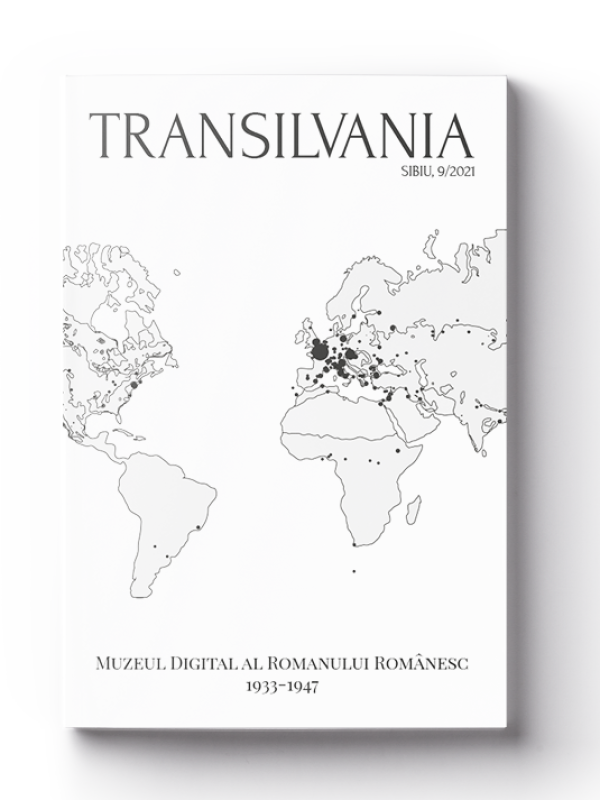
cover site Transilvania 9.2021
Revista: Transilvania
Anul Publicarii:2021
Print ISSN: 0255-0539

Științe socio-umane

Arte vizuale

Filozofie și studii sociale

Antropologie și etnologie

Sociologie

Științe politice & juridice

Istorie & Antropologie

Studii culturale

Biblioteconomie

Științele limbii

Științele economice

Antropologie. Studii filozofice

Teologie

Studii literare

Autor: Ștefan BAGHIU, Andrei TERIAN, Vlad POJOGA, Snejana UNG, Bianca CRĂCIUN, Ovio OLARU
Email: stefan.baghiu@ulbsibiu.ro

The Geography of the Romanian Novel (1933-1947): Spaces from Abroad

Abstract: This article analyzes the ways in which the Romanian novel published between 1933-1947 represents foreign cities, towns, peripheries, and villages in the fictional worlds. It asserts the democratization of the narrative universe through the planetary perspective of the novels and discusses the birth of the Global South imagery. The search was conducted on a corpus of 700 novels in the MDRR archive. The data is disposed through quantifying recurrences (the number of novels in which a city appears) and occurrences (the number of times a city appears) of foreign cities. This article deals with representations of Europe and the Americas, Asia, Africa, and Australia in the 1933-1947 Romanian novel. It separates three main categories (main cities, consolidation cities, and secondary cities) and shows the planetary distribution of space within the Romanian novel.

Keywords: Literary geography, Romanian literature, urban literature, rural sites, planetarity.

Citation suggestion: Baghiu, Ștefan, Andrei Terian, Vlad Pojoga, Snejana Ung, Bianca Crăciun, and Ovio Olaru. “Geografia romanului românesc (1933-1947): străinătatea”. Transilvania, no. 9 (2021): 1-9.

https://doi.org/10.51391/trva.2021.09.01.

Autor: Emanuel MODOC, Nicoleta STRUGARI, Mihnea BÂLICI, Radu VANCU, Ștefan BAGHIU, Vlad POJOGA
Email: ermodoc@gmail.com

The Geography of the romanian novel (1933-1947): the national areal

Abstract: This article analyzes the ways in which the Romanian novel published between 1933-1947 represents cities, towns, peripheries and villages in the fictional worlds. It asserts the democratization of the narrative universe through the novel of the periphery and discusses the birth of the touristic novel, in which characters often spend time in new areas for relaxation. It also challenges the idea of spatial atomization, since the geographical preferences of the authors are usually centralized and gentrified. Almost only subgenre novels and ethnical minority authors are responsible for the democratization of the national geography of the Romanian novel in 1933-1947.

Keywords: literary geography, Romanian literature, urban literature, rural sites.

Citation suggestion: Modoc, Emanuel, Nicoleta Strugari, Mihnea Bâlici, Radu Vancu, Ștefan Baghiu, Vlad Pojoga. “Geografia romanului românesc (1933-1947): arealul național”. Transilvania, no. 9 (2021): 10-17.

https://doi.org/10.51391/trva.2021.09.02.

Autor: Radu VANCU, Alex CIOROGAR, Ana-Maria STOICA Vlad POJOGA, Ștefan BAGHIU
Email: radu.vancu@ulbsibiu.ro

The Internal Temporality of the Romanian Novel (1933-1947)

Abstract: From the point of view of its internal temporality, the Romanian novel between 1933 and 1947 demonstrates an overwhelming preference for negotiating the present. After 1933 the world had already gone through a World War and a world economic crisis – so that the metabolism of the present in post-1933 Romanian novels can also be explained as a post-traumatic shock, an attempt to process the traumatic information of recent history. But the Romanian novel, in its earlier ages, had been synchronous with historical events of relatively comparable magnitude: the European Revolution of 1848, the Crimean War, the Franco-Prussian War of 1870, the Russo-Turkish War of 1877-78, translated in Romania as the War of Independence, the Romanian economic crisis from 1899-1901, the peasant uprising of 1907, with its bloody repression, the Balkan wars, the Great Union of 1918, etc. And yet, this succession of historical events did not have the effect of establishing the historical present as a preferential time of the Romanian novel. Only the Romanian novelist between 1933 and 1947 clearly prefers “recognition” in the present history, in the immediate actuality; the narrative no longer means for him the construction of a patrimonial memory, but almost exclusively a construction of the historical present. Between 1933 and 1947, the Romanian novel is synchronized with its own present.

Keywords: history of the Romanian literature, history of the Romanian novel, Romanian novel between 1933-1947, Digital Museum of the Romanian Novel, time and narrative in the Romanian novel

Citation suggestion: Vancu, Radu, Alex Ciorogar, Ana-Maria Stoica, Vlad Pojoga, Ștefan Baghiu. “Temporalitatea internă a romanului românesc (1933-1947)”. Transilvania, no. 9 (2021): 18-24.

https://doi.org/10.51391/trva.2021.09.03.

Autor: Cătălina STANISLAV, Vlad POJOGA, Daiana GÂRDAN, Ștefan BAGHIU, Bianca CRĂCIUN, Alexandrina SAVIN, Ana-Maria STOICA
Email: catalinastanislav@gmail.ro

Abstract: Following the 2020 article on identity diversity in the Romanian novel, this study provides both a statistical account and individual examples of fictional representations of characters in the Romanian novel between 1933-1947. With a three-fold structure, our essay focuses at first on gender diversity, analyzing the ratios between female and male authors and female and male protagonists. It then concentrates on religious, ethnic, and national minorities, using both quantitative and qualitative methods of analysis, exploring how they are represented and approached. Without drawing any definitive conclusions, our undertaking provides a blueprint for further research on identity representations in the Romanian novel.

Keywords: Romanian literature, Romanian novel, intersectional analysis, gender and literature, fictional representation of minorities.

Citation suggestion: Stanislav, Cătălina, Vlad Pojoga, Daiana Gârdan, Ștefan Baghiu, Bianca Crăciun, Alexandrina Savin, Ana- Maria Stoica. “Diversitate identitară în romanul românesc (1933-1947)”. Transilvania, no. 9 (2021): 25-34.

https://doi.org/10.51391/trva.2021.09.04.

Autor: David MORARIU, Ana-Maria STOICA, Teona FARMATU, Radu VANCU, Dragoș VARGA
Email: david.morariu@ulbsibiu.ro

Production Centers of the Romanian Novel (1933-1947):

Editorial Networks and Canonization Process

Abstract: This article studies the production of the Romanian novel published between 1933 and 1947 by deploying instruments of quantitative analysis. More precisely, based on the corpus resulted from the project The Digital Museum of the Romanian Novel: 1933-1947 (more than 700 digitized novels), our analysis focuses on the canonical writers and their “rivals”, the authors and their novels bypassed by the literary canon, the geographical networks of production and the origin of the authors. The relevance of such a study lies not only in recording the evolution of the Romanian production centers, but also in mapping the formula, the mechanisms and, taking into account the article that analyzes the period 1901-1932, the process of canonization of the Romanian novel published in the first half of the 20th century.

Keywords: Romanian novel, geographical networks, production of the Romanian novel, literary canon, origin of the authors.

Citation suggestion: Morariu, David, Ana-Maria Stoica, Teona Farmatu, Radu Vancu, Dragoș Varga. “Poli de producție ai romanului românesc (1933-1947): rețele editoriale și forme de canonizare”. Transilvania, no. 9 (2021): 35-42.

https://doi.org/10.51391/trva.2021.09.05.

Autor: Andrei TERIAN, Teona FARMATU, Cosmin BORZA, Dragoș VARGA, Alex VĂSIEȘ, David MORARIU
Email: andrei.terian@ulbsibiu.ro

The Genres of the Romanian Novel (1933-1947). A Quantitative Analysis

Abstract: This article puts forward a quantitative account of the subgenres of the Romanian novel during the 1933-1947 period. It shows the massive domination of the social novel and the Bildungsroman and analyzes the dynamics of genre and popular literature – adventure novels, detective fiction, SF, etc. – within the first period of massive literary production in Romanian literature. The article is the result of the MDRR (Muzeul Digital al Romanului Românesc – The Digital Museum of the Romanian Novel) projects, set out to archive the Romanian production of novels from 1845 (the year of the publication of the – arguably – first Romanian novel) to 1947, right before the establishment of the communist regime. The first part is a quantitative analysis of the novels according to DCRR (Dicționarul cronologic al romanului românesc – The Chronological Dictionary of the Romanian Novel). The second part analyzes the “dynamics of popular subgenres,” meaning adventure novels, policiers, SF novels, and children’s literature. The third part envisions “the social novel” as a predilect genre of the interwar period, the fourth occasions a reading of the “historical novel,” while the last two sections describe the evolution of sentimental and psychological novels.

Keywords: Romanian novel, genre literature, literary genre, subgenre.

Citation suggestion: Terian, Andrei, Teona Farmatu, Cosmin Borza, Dragoș Varga, Alex Văsieș, David Morariu. “Genurile romanului românesc (1933-1947). O analiză cantitativă”. Transilvania, no. 9 (2021): 43-54.

https://doi.org/10.51391/trva.2021.09.06.

Autor: Alex CIOROGAR, Jessica Brenda CODINĂ, Alex VĂSIEȘ, Vlad POJOGA, Ștefan BAGHIU, Anca-Simina MARTIN
Email: alexandru.ciorogar@ubbcluj.ro

Abstract: A post-anthropocentric epistemological assemblage becomes indispensable in the investigation of the ecology of the Romanian novel. We examine the interactive relationship of various dynamic systems, such as 1) the evolution of the Romanian novel, 2) the modes of representation of the environment, and 3) the social-political history of the autochthonous space. Using a wide range of methodological perspectives, this paper also examines the relationship between literature and the Earth sciences, thus envisioning a new type of literary history where the Romanian novel should be thought as existing within hyper-objects, such as the climate, agriculture, wilderness, pollution, biosphere, cultural politics, capitalism, or geology. The article finally addresses the issue of zoopoetics both as an object of study in the MDRR digital archive (1845-1947) and as a reading strategy, thus, favoring the relationship between animality and narrativity.

Keywords: ecology, zoopoetics, post-anthropocentrism, digital humanities, Romanian literature, history of the novel.

Citation suggestion: Ciorogar, Alex, Jessica Brenda Codină, Alex Văsieș, Vlad Pojoga, Ștefan Baghiu, Anca-Simina Martin. “Natura în romanul românesc (1845-1947)”. Transilvania, no. 9 (2021): 55-62.

https://doi.org/10.51391/trva.2021.09.07.

Autor: Cătălina RĂDESCU, Maria CHIOREAN, Ștefan BAGHIU, Andreea MÎRȚ, Jessica Brenda CODINĂ, Nicoleta STRUGARI
Email: catalina.radescu@ulbsibiu.ro

Precarity and Cosmopolitism in the Romanian Novel (1845-1947):

Work, Food, Health, Clothing, Fashion

Abstract: The present study dwells on an archive that includes around 85% of the Romanian production of novel from 1845 to 1947 and analyzes the social aspects of daily life in the fictional worlds of realist novels published in this timespan. From work conditions to the rights of employees, from hunger to bountifulness, from modesty to display, two different hemispheres seem to co-exist: a rustical and narrow one of the rural, liminal spaces, and a cosmopolitan and broad one of cities and mobility. Without a doubt, besides this spatial influence over daily life, an even more important one, that sometimes is complementary to the first and sometimes it overarches it is social class. In the mirrored image of the realist Romanian novel until 1947, there is nothing more consequential for individual and collective characters than class, and the differences between classes are closely linked to all dimensions of daily life described in our article.

Keywords: Romanian literature, realist novel, Romanian novel, cosmopolitism, precarity, daily life.

Citation suggestion: Rădescu, Cătălina, Maria Chiorean, Ștefan Baghiu, Andreea Mîrț, Jessica Brenda Codină, Nicoleta Strugari. “Precaritate și cosmopolitism în romanul românesc (1845-1947): muncă, hrană, sănătate, îmbrăcăminte, mondenitate. Transilvania, no. 9 (2021): 63-74.

https://doi.org/10.51391/trva.2021.09.08.

Autor: Maria CHIOREAN, Mihnea BÂLICI, Cătălina STANISLAV, Andreea MÎRȚ, Ovio OLARU, Vlad POJOGA
Email: chiorean.r.maria@gmail.com

Living and Space in the Romanian Novel (1845-1947)

Abstract: This article aims to investigate the depiction of living space(s) and architecture in the Romanian novel between 1844 and 1947. It has a descriptive dimension, discussing the construction of fictional worlds through a series of key-issues: a fascination with urban spaces (with the centralization/ provincialization of urban imagery), the function allowed to women vs. men in various social spheres (certain rooms, certain public fora), the disintegration of urban families, precarious living on the fringes of urban society etc. The authors map the occurrence of such new phenomena or spatial mutations, commenting on their historical context and scope (through statistical analysis). At the same time, there is a more reflexive, theoretical side to our research. Drawing on the work of theorists like Bertrand Westphal, Henri Lefebvre, Nirmal Puwar, and Habermas (to name but a few), this article asks many vital questions pertaining to geocriticism and sociocriticism alike: what is the difference between a place and fictional space; how can we define the public and the private sphere in the Romanian novel through issues like political participation and representation, exclusion, agency, and the right to leisure; how exactly do social norms and relationships contribute to the construction and the organisation of novelistic space?

Keywords: living, space, place, architecture, Romanian Literature, history of the novel

Citation suggestion: Chiorean, Maria, Mihnea Bâlici, Cătălina Stanislav, Andreea Mîrț, Ovio Olaru, Vlad Pojoga. “Locuire și spațiu în romanul românesc (1845-1947)”. Transilvania, no. 9 (2021): 75-85.

https://doi.org/10.51391/trva.2021.09.09.

Autor: Cosmin BORZA, Ovio OLARU, Cătălina RĂDESCU, David MORARIU, Snejana UNG, Alexandrina SAVIN, Anca-Simina MARTIN
Email: cosmi_borza@yahoo.com

Education and School in the Romanian Novel (1845-1947)

Abstract: The article sets out to establish the ways in which the Romanian novelistic production between 1845 and 1947 reflects the challenges and accomplishments of successive efforts at modernising the educational system. Therefore, the case-studies we discuss are focused on some of the major implications of Romanian education: the shifts in the literal spaces in which the educational process is being conducted, the access to books and the social prestige accrued through reading, the link between education and the abroad – including the ambivalent status of foreign language education as platform on which the conflict between nationalism and cosmopolitanism is played out –, the opportunities opened by scientific progress, but also the anxieties it generates.

Keywords: modernising education, school reform, literacy, cosmopolitanism, reading education.

Citation suggestion: Borza, Cosmin, Ovio Olaru, Cătălina Rădescu, David Morariu, Snejana Ung, Alexandrina Savin, Anca- Simina Martin. “Educație și școală în romanul românesc (1845-1947)”. Transilvania, no. 9 (2021): 86-96.

https://doi.org/10.51391/trva.2021.09.10.

1xbet türkiye

Științe vizuale

Dosar

Istorie si studii culturale

Istorie

Științele educației

Filozofie și studii politice

Stiintele comunicarii

Etnografie si folclor

Fizica speculativa

Recenzii

Economie

Artele spectacolului

Eveniment