
Search our journals and articles

7-8 / 2021

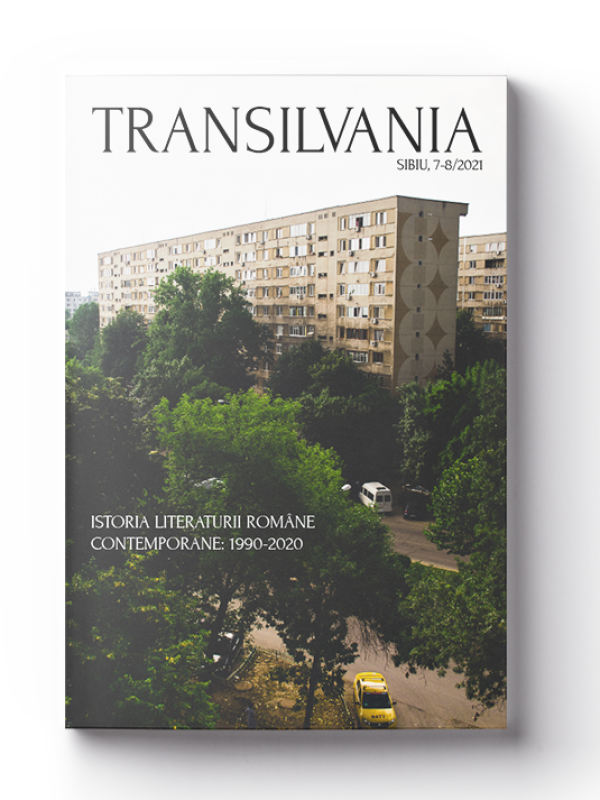
cover site Transilvania 7-8.2021
Revista: 7-8 / 2021
Anul Publicarii:2021
Print ISSN: 0255-0539

Științe socio-umane

Arte vizuale

Filozofie și studii sociale

Antropologie și etnologie

Sociologie

Științe politice & juridice

Istorie & Antropologie

Studii culturale

Biblioteconomie

Științele limbii

Științele economice

Antropologie. Studii filozofice

Teologie

Studii literare

Autor: Christian MORARU
Email: c_moraru@uncg.edu

Literary Historiography as Event: Mihai Iovănel’s History of Contemporary Romanian Literature: 1990-2020

Abstract: In his essay, Moraru contends that Mihai Iovănel’s 2021 History of Contemporary Romanian Literature: 1990-2020 is a breakthrough in Romanian literary historiography and criticism overall. According to Moraru, the History revisits radically the terms of the Romantic contract that, in Romania and elsewhere, has typically been underwriting modern criticism. A form of critical realism and an exemplar of postmillennial Romanian literary and cultural studies, Iovănel’s book is, in Moraru’s view, not only provocative but also effectively transformative. To gauge the scope and nature of the changes advocated and enacted in the History, this article examines how Iovănel has put together what he calls the “system” of contemporary Romanian literature. Thus, Moraru is less concerned with which writers are included in the book and which are left out, seeking, instead, answers to a series of questions concerning primarily Iovănel’s cultural-materialist and transnational studies-informed methodology. Along the same theoretical, historical, and political lines, Moraru discusses the project’s makeup as well as the strength of the case the History makes for the need to have another look at a range of pre- and post-1990 literary movements, directions, styles, and authors, principally at postmodernism and its competition and successors in the twenty-first century.

Keywords: critical contract; critical realism; aesthetics; event; form; generation; ideology; literary historiography; literary realism; materialism; Marxism; paradigm shift; post-Cold War; postmillennial; postmodernism; post-postmodernism; system; transnationalism

Citation suggestion: Moraru, Christian. “Literary Historiography as Event: Mihai Iovănel’s History of Contemporary Romanian Literature: 1990-2020”. Transilvania, no. 7-8 (2021): 1-13.

https://doi.org/10.51391/trva.2021.07-08.01.

Autor: Snejana UNG
Email: snejana.ung@e-uvt.ro

The Challenges of Writing a National Literary History in the Era of Transnationalism: Insights from a Peripheral Literary Space

Abstract: It goes without saying that during the nineteenth and twentieth century literary historiography tries to define national identities. However, a methodological and paradigm shift occur at the beginning of the twenty-first century when, under the auspices of globalization and the emergence of world literature and transnational literary studies, literary historiography is re-thought as a collective and transnational project. Yet, the asymmetry of the world literary system affects literary historiography too. When it comes to this scholarly genre, the asymmetry is most visible in the fact that in the era of transnationalism, national histories are still written at the periphery. Given the aforementioned observation, this paper a) looks into the challenges of writing literary history in Romania in the age of world literature and transnational studies, and b) tries to explain why a national literary history is still needed and how it can change the way we think about Romanian literature. The starting point of this inquiry is represented by the publication of Mihai Iovănel’s Istoria literaturii române contemporane: 1990-2020 [History of Contemporary Romanian Literature: 1990-2020]. In the context of the ‘transnational turn’ in literary studies, the attempt to write relevant national histories in a peripheral literary space such as Romania is faced, in my view, with two major challenges: 1) the fact that transnationalism manifests itself differently at the periphery and 2) the tradition of Romanian literary criticism and history. The former refers to the fact that unlike central literatures, where transnationalism is shaped to a large extent by migrant writers (those who enter these literatures), in Romanian literature it comprises exiled or migrant writers (those who left Romania and not vice versa) and, to a lesser extent, the literatures written by ethnic minorities. A comparative approach can cast light on this difference. For example, while the thirteenth volume of The Oxford English Literary History is dedicated entirely to migrant and bicultural writers, transnational histories concerning the peripheries, such as History of the Literary Cultures of East-Central Europe, focus on multiple literary spaces and therefore have a different approach to dealing with transnationalism. The latter challenge is represented, as shown by Iovănel, by the long-lasting tradition of the “principle of aesthetic autonomism”, which persists even in post-communist Romania. In this regard, this paper aims to show that Iovănel’s History… overcomes the above-mentioned hindrances of literary criticism and succeeds in offering an image of Romanian literature not as confined to its national boundaries but as part of the world literary system. Along with other significant scholarly works on Romanian literature as and in world literature, this project is a significant step towards re-thinking Romanian literature as a “literature of the world” (Terian 2015).

Keywords: literary history, transnationalism, Romanian literature, world literature, periphery.

Citation suggestion: Ung, Snejana. “The Challenges of Writing a National Literary History in the Era of Transnationalism:

Insights from a Peripheral Literary Space”. Transilvania, no. 7-8 (2021): 14-21.

https://doi.org/10.51391/trva.2021.07-08.02.

Autor: Maria CHIOREAN
Email: chiorean.r.maria@gmail.com

Iovănel’s Sociology and the Utility of Pop Culture. Analyzing the Contemporary Understanding of Literary Marginality in Romania

Abstract: This article analyzes the role of cultural sociology and elements of pop culture when exploring the current relationship between Romanian literature and the world literary system. I use Mihai Iovănel’s work (his recent History, as well as previous research) as a springboard into a discussion about the paradoxes and the disputes characterizing contemporary World Literature studies and I argue that his employment of materialism and cultural sociology alike helps move past some of the blind spots of the discipline. The final section of the article then shows that Iovănel’s focus on popular culture also informs his understanding of literary circulation, highlighting its unpredictable and non-linear nature.

Keywords: World Literature, cultural sociology, materialism, temporality, pop culture, literary history, Mihai Iovănel.

Citation suggestion: Chiorean, Maria. “Iovănel’s Sociology and the Utility of Pop Culture. Analyzing the Contemporary Understanding of Literary Marginality in Romania”. Transilvania, no. 7-8 (2021): 22-31.

https://doi.org/10.51391/trva.2021.07-08.03.

Autor: Ovio OLARU
Email: ovio.olaru@ulbsibiu.ro

Who’s afraid of Mihai Iovănel? Regimes of Relevance and New Literary Historiography

Abstract: The present article addresses Mihai Iovănel’s recently published History of Contemporary Romanian Literature: 1990- 2020 while pursuing a series of similarities with other contributions to postcommunist national literatures in the Central and Eastern European cultural space, on the one hand, and with previous ways of understanding the concept of literary history, on the other. The article argues that Iovănel’s History is one of the first to assess the importance of the social in the production, study, and national, as well as transnational dissemination of Romanian literature, an emphasis without which the study of literary phenomena risks falling into the blindness of aesthetic autonomy, whose shortcomings are well documented in the book. Lastly, I will argue that Iovănel unwillingly describes several of the most notable shifts in the “regimes of relevance” (Galin Tihanov) that literature has undergone from the communist period to contemporary times.

Keywords: regimes of relevance, literary history, Romanian literature, literary historiography, Mihai Iovănel.

Citation suggestion: Olaru, Ovio. “Who’s afraid of Mihai Iovănel? Regimes of Relevance and New Literary Historiography”. Transilvania, no. 7-8 (2021): 32-44.

https://doi.org/10.51391/trva.2021.07-08.04.

Autor: Ana ȚĂRANU
Email: taranuanamaria@gmail.com

Abstract: Premised on the pervasiveness of generic categories within literary historiography, the present analysis attempts to delineate the generic idioms present within three histories of Romanian literature (authored by G. Călinescu, Nicolae Manolescu and Mihai Iovănel, respectively). Engaging a descriptively historical, rather than theoretical, approach to genre and its metadiscourses, the paper begins with an abridged version of the cardinal disputes of genre criticism. Subsequently, it comparatively addresses the presence of genre within the three volumes, aiming to locate them within recognizable frameworks of genericity and to establish the overlapping territories of their generic landscapes. Thus, it distinguishes G. Călinescu as a practitioner of post-Romantic genre theory, further showcasing how some of his central aestheticist positions survive in Nicolae Manolescu’s moderately formalist account of the issue. Against the backdrop of their more conservative, teleological historiographical projects, Mihai Iovănel’s 2021 Istoria Literaturii Române Contemporane 1990-2020 [The History of Contemporary Romanian Literature 1990-2020] displays a distinct methodological apparatus, predicated on the author’s rejection of the paradigmatic autonomy of the aesthetic. His employment of materialist theories of art is corelative to a conception of genre as a contingent, empirically determined instrument of analysis, which, far from being a rhetorically stable, abstract category, actively mediates the relationship between social and aesthetic history. This shift engenders substantial amendments to the physiognomy of literary history as genre, enabling it to encompass extra-literary (and noncanonical) phenomena.

Keywords: literary genres, literary history, Romanian literature, Mihai Iovănel.

Citation suggestion: Țăranu, Ana. “Genre Practice in Literary Historiography: A Romanian Case”. Transilvania, no. 7-8 (2021): 45-51. https://doi.org/10.51391/trva.2021.07-08.05.

Autor: Ioana MOROȘAN
Email: morosan.gyongyi@gmail.com

Systemic Reading in Literary Historiography: Politicisation and Instrumentalization of the Autonomy of the Aesthetic as a Strategy of Repositioning During the 90s

Abstract: The present paper proposes to follow the evolution of the principle of the autonomy of the aesthetic during the 90’s, with a special focus on the discrepancy between its discourse and its practice, in contrast to its instantiation as a systemically challenging discourse before ’89. Starting from Mihai Iovănel’s recent landmark literary historiographical project History of Contemporary Romanian Literature: 1990-2020, put in conjunction with Gisèle Sapiro’s research on the relative nature of the autonomy in the field theory, the present study aims to show how inside of the Romanian literary field, the concept of autonomy was always instrumentalised towards certain political and ideological interests. These implicit biases are revealed as the actual function of the autonomist discourse via the contextualizing and sociological analyses performed by Iovănel which makes manifest the extra-literary facts surrounding the events within the field. Such an understanding of the autonomy of the aesthetic is also informed by Gisele Sapiro’s theoretical contributions, thus revealing the relative nature of the autonomy and its political and ideological function within the local literary field.

Keywords: autonomy of the aesthetic, Romanian literary field during the 90’s, political and ideological instrumentalisation of the autonomist discourse, new paradigms in Romanian literary historiographical studies.

Citation suggestion: Moroșan, Ioana. “Systemic Reading in Literary Historiography: Politicisation and Instrumentalization of the Autonomy of the Aesthetic as a Strategy of Repositioning During the 90s”. Transilvania, no. 7-8 (2021): 52-60.

https://doi.org/10.51391/trva.2021.07-08.06.

Autor: Adriana STAN
Email: adrstan@yahoo.ca

Archaeologies of the Present in The History of Contemporary

Romanian Literature: 1990-2020

Abstract: The paper disscusses the literary-historiographical enterprise of Mihai Iovănel’s History of the Contemporary Romanian Literature: 1990-2000 as a turning point in respect with the twofold aesthetic and ethnocentric dominant of this genre in Romania, whose tradition that is traceable back to the pos-Thaw period prolongs into postcommunism. Iovănel’s self-claimed ”postmarxist” approach puts under a deconstructive lens the ideological embededness of the Romanian literary space, whose postcommunist avatar still owes largely to its communist heritage by its indebtment to dominantly conservative and right ideologies. It also switches the analytical focus of the literary history towards the material (i.e. social, institutional, and so forth) conditions of the literary production per se. My essays develops two basic critical points derived from the above-mentioned premises. One concerns the topicality of the literary historian’s leftist vantage point in the view of deciphering long-engrained myths of the national literature and of its criticism, thus providing a clearer, more realist picture of its concrete phenomena. The other debates the utility and eventual drawbacks of the retrospective analysis the historian is forced to assume in order to achieve his deconstructive task, a retrospection that pushes his investigation way behind the confines of ”contemporaneity”.

Keywords: ideology, realism, aestheticism, (post)communism, Marxism.

Citation suggestion: Stan, Adriana. “Arheologii ale prezentului în Istoria literaturii române contemporane: 1990-2020”. Transilvania, no. 7-8 (2021): 61-66.

https://doi.org/10.51391/trva.2021.07-08.07.


ACKNOWLEDGEMENT: This work was supported by a grant of the Romanian Ministry of Research and Innovation, CNCS – UEFISCDI, project number PN-III-P4-ID-PCE-2020-2026, within PNCDI III.

Autor: Costi ROGOZANU
Email: costel.rogozanu@ulbsibiu.ro

When Everything is Lost, Be Careful to Fall in Style. Iovănel’s History: Notes, Additions, Challenges

Abstract: I will analyse the correspondences between two critical ambitions cultivated a century apart, those of the liberal ideological critic Lovinescu and of a young literary critic who reads Romanian literature through a minimally progressive grid, sensible to liberal nuances and with leftist interpretative undertones (considering the evolution of class representation and of the “social”) in discussing recent literature, a point of view having a devastating effect on many writers (in light of the fact that the regime change has occasioned an upsurge in racism, sexism, and all other imaginable phobias, which have nonetheless been cultivated in the last stage of nationalist propaganda of the 70s-80s as well). I will pursue the evolution of several writers against the backdrop of the ideological mainstream, as well as the manner in which Iovănel interprets them: Mircea Cărtărescu, Adrian Schiop, and Lavinia Braniște. I will also attempt to establish the limitations of Iovănel’s approach, residing in the conflict between established literary criticism and a literary production which has been completely underprivileged within the free market, enjoying weak institutional support, and whose sales and popularity are rapidly diminishing. The literary critic, still part of a somewhat stable institutional network, seems to be confined in a depressingly marginal literary underbrush, whose growth was sparked by the cataclysm of anti-communist “cultural revolution” and savage capitalism. One of the greatest constructs of communist modernity, mass culture, which was to transform into one of the greatest post-communist utopias, commercial culture, was of great importance for the present debate.

Keywords: Literary History, Romanian Literature, Mihai Iovănel, ideology, contemporary literature

Citation suggestion: Rogozanu, Costi. “Când totul e pierdut, ai grijă să cazi cu stil. Istoria lui Iovănel: note, completări, provocări”. Transilvania, no. 7-8 (2021): 67-79.

https://doi.org/10.51391/trva.2021.07-08.08.

Autor: Ștefan BAGHIU
Email: stefan.baghiu@ulbsibiu.ro

Ideological Critique in the Era of Leftist Administrative Language: A New Left History of Contemporary Romanian Literature

Abstract: As Teodora Dumitru (2016) has convincingly argued in the case of Romanian literary critic Eugen Lovinescu, the evaluation of literature he proposed along his History of Contemporary Romanian Literature (1926-1929) was guided by a solid liberal and bourgeois drive. Claiming the autonomy of the aesthetics, Lovinescu actually built an urban bourgeois literary canon in his effort to systematize the local literary material. Almost 100 years later, Mihai Iovănel’s History of Contemporary Romanian Literature: 1990-2020 (2021) proceeds to a similar effort, but through the lens of New Left critical theory. Both Lovinescu and Iovănel use what I call the administrative language of their time: Lovinescu uses the urban bourgeois synchronism in order to counter the populists’ movements at the time, while Iovănel uses New Left critique in order to counter the vocabulary of the right-wing populists in contemporary Romania. Those are both the mainstream intelligentsia vocabularies of their time: the liberal discourse was the pillar of developmentalism, while the socialist contemporary vocabulary is more and more put to work in order to secure welfare capitalism. The question that arises is how does Iovănel’s history fulfill its goal of recovering the margins, creating a more democratic canon and imposing intersectionality as a center pillar of literary history, while trying to depart from local provincialism and, thus, gentrifying his research time after time.

Keywords: Mihai Iovănel, History of Romanian Literature, Marxist Theory, Literary Studies, Contemporary Literature.

Citation suggestion: Baghiu, Ștefan. “Critica ideologică în epoca limbajului administrativ de stânga: o istorie New Left a literaturii române contemporane”. Transilvania, no. 7-8 (2021): 80-89.

https://doi.org/10.51391/trva.2021.07-08.09.

Autor: Dan NEUMAN
Email: danalexandru23@yahoo.com

The Contemporaneity of Literature – A Matter of Method

Abstract:The following article critically deals with Mihai Iovănel’s Istoria literaturii române contemporane. 1990-2020 [The History of Contemporary Romanian Literature. 1990-2020] (Polirom, 2021) from three different, yet intertwined, perspectives, namely 1) the methodological turn, highlighted by an overt post-Marxist attempt at interpreting contemporary Romanian literature, 2) the question of what is – or if there is any – literariness in Istoria literaturii române contemporane. 1990-2020, 3) the issue of transcending normative aesthetics into post-aestheticism as a last resort or perhaps as a new dead-end. Finally, the ideological threshold that divides – or rather emphasis – local national literature as substantially distinct from global literature will be tentatively broached.

Keywords: Romanian literature, post-Marxism, literary criticism, ideology.

Citation suggestion: Neuman, Dan. “Contemporaneitatea literaturii – o chestiune de metodă”. Transilvania, no. 7-8 (2021): 90-102.

https://doi.org/10.51391/trva.2021.07-08.10.

Autor: Iulian BOCAI
Email: iulibocai@gmail.com

The Critique of Ideology in the Culture of Dictionaries

Abstract: Literary history is still the most successful strategy of systematizing knowledge in Romanian academe and, although the theoretical revolution that took place in literary studies between 1960-1990 did not leave it unscathed, it remains the methodological anchor of every attempt at trying to make sense of the entirety of a specific culture. In this paper I analyze Mihai Iovănel’s new History of Contemporary Romanian Literature and whether it succeeds in revolutionizing (methodologically or in terms of cultural analysis) an old and robust genre of explanation, in an intellectual culture that is otherwise enamored with dictionaries, encyclopedias and all-encompassing narratives of the past.

Keywords: Literary history, Mihai Iovănel, Romanian literature, contemporary literature, postcommunism

Citation suggestion: Bocai, Iulian. “Critica ideologiei în cultura dicționarului”. Transilvania, no. 7-8 (2021): 103-106.

https://doi.org/10.51391/trva.2021.07-08.11.

Autor: Doris MIRONESCU
Email: dorismironescu@yahoo.com

Regimes of Relevance, Resistance Points: Romanian Literature during Postcommunism

Abstract: The article discusses the condition of literary history at a time of disciplinary crisis, when literary studies appear, globally, to renegotiate their connection to the social and to social sciences. In trying to articulate ways for literary history to incorporate more socially aware concepts in its practice, I turn to two recent proposals by Galin Tihanov (“regimes of relevance”) and Mihai Iovănel (“resistance points”). Finally, the article applies the finds of both concepts to postcommunist Romanian literature in an attempt to reach a more supple and at the same time comprehensive angle.

Keywords: Mihai Iovănel, History of Contemporary Romanian Literature 1990-2000, Regimes of Relevance, Resistance Points.

Citation suggestion: Mironescu, Doris. “Regimuri de relevanță, puncte de rezistență: literatura română în postcomunism”. Transilvania, no. 7-8 (2021): 107-114.

https://doi.org/10.51391/trva.2021.07-08.12.

Autor: Victor COBUZ
Email: cobuzvictor@gmail.com

The Picture of Contemporary Prose and the Valences of Realism in The History of Romanian Contemporary Literature: 1990-2020 by Mihai Iovănel

Abstract: In an era in which literary histories are written by collective of academics trying to transcend the national paradigm in which these works were once wrote, The History of Contemporary Romanian Literature: 1990-2020 by Mihai Iovănel is an intellectual effort that may seem obsolete. Nevertheless, Mihai Iovănel’s book proposes new ways of understanding the contemporary Romanian literary field that were not taken into consideration by previous similar critical endeavours. This paper aims to investigate how The History of Contemporary Romanian Literature constructs an overview of the Romanian fiction wrote in the last three decades and the critical approaches deployed for this purpose. The main interest of this article will be how does Mihai Iovănel discusses Romanian contemporary fiction and how does he instrumentalizes the concept of realism. We will look more closely at the third part of the book, “The Evolution of Fiction,” but the discussion will not omit the relation of this chapter with others. The paper will concentrate on the concepts put forward by Mihai Iovănel to systematize the complex subfield of contemporary Romanian fiction, like capitalist realism, the famous term coined by Mark Fisher. Also, we will try to see how The History of Contemporary Romanian Literature relate to previous literary histories or books of literary criticism that resembles Mihai Iovănel’s work in some respects or that have similar goals but different methods.

Keywords: Romanian literary historiography, ideological criticism of fiction, realism, capitalist realism.

Citation suggestion: Cobuz, Victor. “Tabloul prozei contemporane și valențele realismului în Istoria literaturii române contemporane: 1990-2020 de Mihai Iovănel”. Transilvania, no. 7-8 (2021): 115-122.

https://doi.org/10.51391/trva.2021.07-08.13.

Autor: Cosmin BORZA
Email: cosmi_borza@yahoo.com

The Western Canon in The History of Contemporary Romanian Literature: 1990-2020 by Mihai Iovănel

Abstract: This paper focuses on the strategies enacted by Mihai Iovănelʼs History in order to map the transnational interactions of contemporary Romanian literature. Since Iovănel emphasizes that, starting with the 2000s, the Romanian writers define themselves mainly through the global networks in which they try to integrate, this article aims to analyse: a) the canonical function acquired by the local references to World Literature; b) their explanatory role compared to the one played by the closed circuit of the so-called “intra-national” comparisons; c) the theoretical legitimacy of the “transnational canon” projected by Iovănel in the epilogue of his History.

Keywords: contemporary Romanian literature, transnational canon, literary history, global networks, Mihai Iovănel.

Citation suggestion: Borza, Cosmin. “Canonul occidental din Istoria literaturii române contemporane: 1990-2020 de Mihai Iovănel”. Transilvania, no. 7-8(2021): 123-127.

https://doi.org/10.51391/trva.2021.07-08.14.

Autor: Emilia DAVID
Email: emilia.david@unipi.it

Abstract: The present article will try to highlight a series of innovations brought about by Mihai Iovănel’s History of Contemporary Romanian Literature 1990-2020 in the current evaluation and critical interpretation of Romanian literature. Singular in terms of the length of the period under scrutiny and the general objectives pursued by its author, the History views literature as an overarching institution governed by its own mechanisms. The latter are both extraliterary – drawing on historical, sociological, and critical markers – and artistic – explorable by invoking the aesthetic standpoint alone. By discussing the insistence on the first type of mechanisms, I will present one of the major elements of novelty brought by the volume in the contemporary cultural landscape of Romania. Placing myself, therefore, on the position of the “local” reader, i.e., as a connoisseur of the evolution of the contemporary Romanian literary system, I will examine, on the one hand, the ways in which Mihai Iovănel discusses and redefines prevalent concepts in literary theory and criticism, while on the other, I will perform the critical – but also pedagogic – role of the expert who wants to present to a “foreign” public – belonging to another country and culture, that is – the national literature as “literature of the world.” Iovănel employs a set of adequate and representative instruments of study and analysis in showing that Romanian literature is a cultural phenomenon engaging in a constant dialogue with European and universal paradigms and models.

Keywords: History of literature, history of contemporary literature, literary criticism, ideology, postmodernism, neo-expressionism, transnational.

Citation suggestion: David, Emilia. “De la canonul optzecist la canonul transnațional” Transilvania, no. 7-8 (2021): 128-132.

https://doi.org/10.51391/trva.2021.07-08.15.

Autor: Victor MOROZOV
Email: victormorozov2015@gmail.com

Quasi Live: The Event of the Romanian Revolution in Mihai Iovănel’s History

Abstract: This essay aims to examine several means by which literary historian and critic Mihai Iovănel grounds his synthesis work around the seminal moment of the Romanian revolution. It proceeds by defining two central occurrences of that event throughout the volume – as a temporary marker, useful insofar as it manages to divide more or less arbitrarily a historic period, and as a source for the narratives that would develop in quick response to the brutal transition towards capitalism. The article questions the meaning of the choice to engage the contemporary history starting from the Romanian revolution, while also pointing out the media transformations that this globally televised event brought to the literary field.

Keywords: revolution, television, conspiracy theory, postcommunism, literary history

Citation suggestion: Morozov, Victor. “Cvasi în direct: evenimentul revoluției române în Istoria lui Mihai Iovănel”. Transilvania, no. 7-8 (2021): 133-138. https://doi.org/10.51391/trva.2021.07-08.16.

Autor: Radu VANCU
Email: radu.vancu@ulbsibiu.ro

The First Leftist Mythos of Contemporary Romanian Literature

Abstract: Mihai Iovănel’s History of Contemporary Romanian Literature: 1990-2020 is the first leftist major narrative of Romanian literature – and the shockwaves it generated were due even more to this firm ideological option (the first such one in the history of major Romanian literary histories) than to its literary content proper. The present article aims at asserting the main three accomplishments and shortcomings generated by this ideological option – namely that: i) it succeeds in coalescing the first coherent narrative of the last three decades of Romanian literature; ii) it sometimes turns from an ideological option into an ideological bias – and modifies the factuality of Romanian literature, eliminating important writers, exaggerating the qualities of some other ones, searching to distribute merits (to leftist writers) and punishments (to right-wing ones) according with their political option, and not with their literary qualifications; iii) it is an impressive stylistic achievement in itself, even though quite ironically its author disregards the virtues of aestheticism.

Keywords: history of contemporary Romanian literature, Mihai Iovănel, cultural left versus cultural right, cultural wars, Romanian literary histories

Citation suggestion: Vancu, Radu. “Primul mythos de stânga al literaturii române contemporane”. Transilvania, no. 7-8 (2021): 139-143. https://doi.org/10.51391/trva.2021.07-08.17.

Autor: Vlad POJOGA
Email: vlad.pojoga@ulbsibiu.ro

The Operationalization of Experiment in Romanian Literary Criticism

Abstract: This study has a two-fold structure, in its first part exploring various models of experimental literature, proposed by researchers such as Gerald Prince and Warren Motte, as well as theoretical attempts to define and analyze experimental literature in Romania. The second part focuses on the quantitative analysis of keywords related to “the experimental” found in literary histories of Romanian literature authored by E. Lovinescu, G. Călinescu, Nicolae Manolescu, and Mihai Iovănel, as well as The General Dictionary of Romanian Literature and The Chronological Dictionary of the Romanian Novel. By simply searching several pointedly chosen terms in the corpus, a cartography of what is considered to be experimental emerges clearly, alongside its relation to the canon, to the dynamics of literary genres, and to the temporal evolution of Romanian literature.

Keywords: quantitative analysis; keyword analysis; Romanian literary histories; experimental literature.

Citation suggestion: Pojoga, Vlad. “Operaționalizarea experimentului în critica literară românească”. Transilvania, no. 7-8 (2021): 144-152.

https://doi.org/10.51391/trva.2021.07-08.18.

Științe vizuale

Dosar

Istorie si studii culturale

Istorie

Științele educației

Filozofie și studii politice

Stiintele comunicarii

Etnografie si folclor

Fizica speculativa

Recenzii

Economie

Artele spectacolului

Eveniment