
Search our journals and articles

4 / 2025

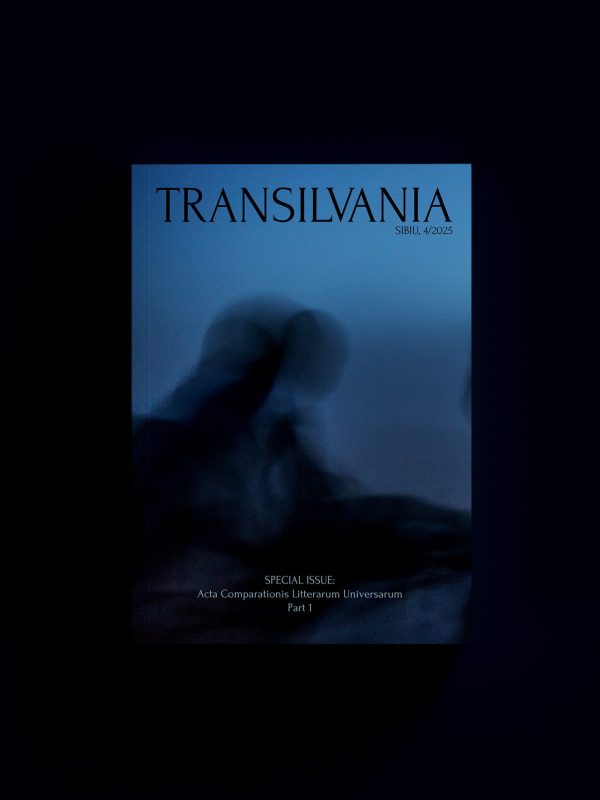
featured Transilvania 4.2025
Revista: 4 / 2025
Anul Publicarii:2025
Print ISSN: Print ISSN 0255-0539; Electronic ISSN 3061-2217

Științe socio-umane

Arte vizuale

Filozofie și studii sociale

Antropologie și etnologie

Sociologie

Științe politice & juridice

Istorie & Antropologie

Studii culturale

Biblioteconomie

Științele limbii

Științele economice

Antropologie. Studii filozofice

Teologie

Studii literare

Autor: Anca Parvulescu, Alex Goldiș, Levente T. Szabó
Email: ancaparvulescu@wustl.edu

Abstract: This Special Issue re-examines Acta Comparationis Litterarum Universarum (1877–1888), celebrated in recent years as the first journal of comparative literature. It resists a hagiographic recuperation of its editor, Hugo Meltzl, to reveal the journal’s entanglements with the political, epistemological or linguistic structures of the Austro-Hungarian Empire and its wider inter-imperial context. The essays in the Special Issue cast new light on subaltern literatures and neglected individual contributors—women, Romani, Jewish—and foreground the journal’s clash between an all-encompassing archiving ambition and its hierarchical presumptions. We foreground both the journal’s indebtedness to nineteenth century epistemology (stadial change, organicism, racialization) and its pivotal role in shaping future comparative literature.

Keywords: Acta Comparationis Litterarum Universarum, Hugo Meltzl, Austro-Hungarian empire, comparative literature, multilingualism, archive.

Acknowledgement: This work was funded by the EU’s NextGenerationEU instrument through the National Recovery and Resilience Plan of Romania—Pillar III-C9-18, through the project A Global History of Romanian Comparatism: A Case Study in Inter-Imperial Comparative Literature (1877-1944), PNRR-III-C9-2023-I8-CF 22/27.07.2023, contract no. 760276/26.03.2024.

Autor: Christian Moraru
Email: c_moraru@uncg.edu

Abstract: The essay seeks to assess the contemporary epistemological and political benefits of revisiting the Acta Comparationis Litterarum Universarum archive, in particular Hugo Meltzl’s more theoretical contributions to it. Simply speaking, the central objective here is to think “with” Meltzl’s world about the twenty-first-century world. Mapping the former onto the latter, Christian Moraru proposes, may potentially invigorate our efforts as comparatists and even citizens at present. Following some deliberately presentist methodological clarifications and loosely in dialogue with recent interventions in world theory, actor-network analysis, and agential-speculative realism, Moraru wonders about the extent to which what he calls the “Meltz world” may afford less hierarchical world- and earth systems, ontologies, and attendant critical insights, probing angles, and Auerbachian Ansatzpunkte. Further, if such affordances obtain in Meltzl and elsewhere in the Acta Comparationis, then how might one deploy them methodologically today? How about Meltzl’s Transylvania as “method,” as “Transylvanianism”? And how about the world-reading and worldbuilding possibilities they open up or foreclose? The paper concludes with a decalogue—a rejoinder of sorts to Meltz’s “decaglotism”—answering these and related questions.

Keywords: Hugo Meltzl, Sámuel Brassai, Johann Wolfgang von Goethe, Erich Auerbach, Ansatzpunkt, Acta Comparationis Litterarum Universarum, comparatism, World Literature, world theory, world-reading/worldbuilding, presentism, Transylvania as method, “Transylvanianism,” nationalism, imperialism, epistemology, ontology

Acknowledgement: This work was funded by the EU’s NextGenerationEU instrument through the National Recovery and Resilience Plan of Romania—Pillar III-C9-18, through the project A Global History of Romanian Comparatism: A Case Study in Inter-Imperial Comparative Literature (1877-1944), PNRR-III-C9-2023-I8-CF 22/27.07.2023, contract no. 760276/26.03.2024.

Autor: Alex Goldiș
Email: alexandru.goldis@ubbcluj.ro

Abstract: This article examines the role of Hugo Meltzl and the journal Acta Comparationis Litterarum Universarum in shaping the field of comparative literature in the context of World Literature debates. While recent contributions have heralded Meltzl as a pioneering figure advocating for a non-Western-centric foundation of comparatism, the study pleads for a historicized reassessment of Acta Comparationis as a product of the Austro-Hungarian Empireʼs linguistic and identity politics. This exploration reveals the interplay between Meltzlʼs advocacy for polyglottism and the imperial agendas of his time, suggesting that his contributions were shaped by the political and cultural dynamics of the Habsburg context. Lastly, the article scrutinizes Meltzlʼs approach to minor literatures, revealing both an archival ambition, in line with the anthropological presuppositions of the nineteenth century, and a tendency to frame these literatures within Eurocentric paradigms. A close examination of the journal uncovers the tensions between Meltzl’s universalist ambitions and the realities of cultural or political hierarchies that molded the Acta Comparationisʼs actual material.
norabahis
Keywords: Hugo Meltzl, comparative literature, postcolonialism, Acta Comparationis Litterarum Universarum, Austro-Hungarian empire.

iskenderun escort,
iskenderun escort,
iskenderun escort,
hatay escort,
iskenderun escort,
iskenderun escort,
iskenderun escort,
iskenderun escort,
iskenderun escort,
iskenderun escort,
iskenderun escort,
iskenderun escort,
antakya escort,
antakya escort,
bursa escort,
görükle escort,
bursa escort,
bursa escort,
hatay escort,
diyarbakır escort,
diyarbakır escort,
diyarbakır escort,
elazığ escort,
elazığ escort,
elazığ escort,
arsuz escort,
arsuz escort,
denizli escort,
denizli escort,
denizli escort,
denizli escort,
denizli escort,
denizli escort,
denizli escort,
denizli escort,
denizli escort,
denizli escort,
denizli escort,
denizli escort,
denizli escort,
denizli escort,
denizli escort,
denizli escort,
denizli escort,
denizli escort,
adana escort,
adana escort,
adana escort,
adana escort,
adana escort,
adana escort,
malatya escort,
malatya escort,
eskişehir escort,
eskişehir escort,
manisa escort,
izmit escort,
izmit escort,
izmit escort,
izmit escort,
izmit escort,
izmit escort,
izmit escort,
izmit escort,
izmit escort,
ısparta escort,
ankara escort,
ankara escort,
gaziantep escort,
gaziantep escort,
gaziantep escort,
gaziantep escort,
gaziantep escort,
gaziantep escort,
gaziantep escort,
gaziantep escort,
seks hikayeleri,
erotik hikayeleri,
erotik seks hikayeleri,
sakarya escort,
sakarya escort,
sakarya escort,
van escort,
van escort,
mersin escort,
mersin escort,
istanbul escort,
izmir escort,
izmir escort,
samsun escort,
konya escort,
konya escort,
konya escort,
konya escort,
konya escort,
erzurum escort,
erzurum escort,
malatya escort,
alanya escort,
rent a car chisinau,
Chirie Auto Chisinau,
chirie auto chisinau
chirie auto,
porno izle,
porno,
porno izle,
turk porno,
sikis izle,
porna,
xhamster,
rus porno,
anal porno,
porno seyret,
tük porno,
amatör porno,
liseli porno,
hd porno,
sarışın porno,
mobil porno,
xnxx porno,
Eskişehir escort,
izmir escort,
erzurum escort,
erzurum escort,
iskenderun escort,
iskenderun escort,
iskenderun escort,
denizli escort,
denizli escort,
denizli escort,
denizli escort,
antalya escort,
denizli escort,

Acknowledgement: This work was funded by the EU’s NextGenerationEU instrument through the National Recovery and Resilience Plan of Romania—Pillar III-C9-18, through the project A Global History of Romanian Comparatism: A Case Study in Inter-Imperial Comparative Literature (1877-1944), PNRR-III-C9-2023-I8-CF 22/27.07.2023, contract no. 760276/26.03.2024.

Autor: Manuela Boatcă
Email: manuela.boatca@soziologie.uni-freiburg.de

Abstract: Current European politics of memory and discourses of Europeanness rarely include Europe’s Romani population, despite Romani people’s long history on the continent and their five-hundred-year enslavement on the territory of today’s Romania. The article draws on Michel Rolph Trouillot’s notion of “unthinkable history” in order to address the systematic production of Romani people as unthinkable Others in the European context. I argue that what counts as Europe today mirrors an existing, self-proclaimed “heroic Europe” in the West of the continent that has been shaped by an Occidentalist worldview emerged during Europe’s colonial expansion. Acta Comparationis Litterarum Universarum was complicit in this project. After embedding the production of Otherness in larger discourses of Europeanness in the first part, the article zooms in on the Roma as unthinkable Others in the second. The final section discusses Acta Comparationis’ ambivalent role with respect to Romani knowledge production as an instance of Occidentalist construction of Europeanness. 

Keywords: enslavement, politics of memory, Romani Europeans, Europe, racism, Orientalism, Occidentalism

Acknowledgement: Manuela Boatcă’s work was funded by the EU’s NextGenerationEU instrument through the National Recovery and Resilience Plan of Romania—Pillar III-C9-18, through the project A Global History of Romanian Comparatism: A Case Study in Inter-Imperial Comparative Literature (1877-1944), PNRR-III-C9-2023-I8-CF 22/27.07.2023, contract no. 760276/26.03.2024.

Autor: Levente T. Szabó
Email: tszabo.levente@ubbcluj.ro

Abstract: The article uncovers a previously neglected network of early women comparatists whose contributions to Acta Comparationis Litterarum Universarum fundamentally shaped the emerging discipline of comparative literature. Moving beyond tokenistic recovery, it highlights the intellectual agency and methodological innovations of figures like Dora    d’Istria, Lucy Lloyd, Teréz Tini, and Helene von Meltzl. By applying an intersectional lens, it reveals how gender, ethnicity, and class structured both visibility and exclusion in the journal’s transnational network. The study also reframes the Acta Comparationis not as a solitary intellectual endeavor but as a dynamic interface of weak ties that catalyzed comparative thought across cultural peripheries. This approach not only challenges foundational myths of the discipline but also proposes a new, networked understanding of early literary comparatism.

Keywords: Acta Comparationis Litterarum Universarum, early women comparatists, Dora d’Istria, Helene von Meltzl, Teréz/Theresie Tini, Lucy Lloyd, early networks of comparative literature

Acknowledgement: This work was funded by the EU’s NextGenerationEU instrument through the National Recovery and Resilience Plan of Romania—Pillar III-C9-18, through the project A Global History of Romanian Comparatism: A Case Study in Inter-Imperial Comparative Literature (1877–1944), PNRR-III-C9–2023-I8-CF 22/27.07.2023, contract no. 760276/26.03.2024.


Autor: Maria Luiza Medeleanu
Email: maria.irimia@ubbcluj.ro

Abstract: This essay examines the status of Rromani language and literature in Acta Comparationis Litterarum Universarum, the world’s first journal of comparative literature. Specifically, I discuss how the presence of Rromani folk songs and translations in this nineteenth century Transylvanian academic publication can be understood within broader linguistic, political, and colonial frameworks. Does this presence show genuine appreciation for Rromani culture, or is it part of a European colonial epistemology that racialized the Roma as the “inner Orientals” of Europe? The essay contextualizes Acta’s publication of Rromani texts in light of the broader European academic discourse on Roma, paying  special attention to the influence of “Gypsylorism,” an intellectual tradition that exoticizes and racializes Roma communities. My analysis highlights the agency of nineteenth-century Roma intellectuals, their efforts to standardize Rromani lannguage, and their struggles for cultural and political recognition within the Austro-Hungarian Empire. The essay concludes by assessing the journal’s contribution to the field of Romani Studies and the development of Rromani literature.

Keywords: Rromani language, comparative literature, Acta Comparationis, Romani Studies

Acknowledgement: This work was funded by the EU’s NextGenerationEU instrument through the National Recovery and Resilience Plan of Romania—Pillar III-C9-18, through the project A Global History of Romanian Comparatism: A Case Study in Inter-Imperial Comparative Literature (1877–1944), PNRR-III-C9–2023-I8-CF 22/27.07.2023, contract no. 760276/26.03.2024.


Autor: Maria Mădălina Irimia
Email: maria.irimia@ubbcluj.ro

Abstract: The purpose of this article is to introduce the work of the Jewish scholar Moses Schwarzfeld in the field of Romanian and Jewish Folklore. He explored how folklore influenced Jewish identity in the nineteenth century, especially in a context where Jewish participation in this field was viewed as an unauthorized trespass into a cultural space to be solely Romanian. According to Schwarzfeld, folklore played a central role in shaping Jewish identity. Based on the principles of “Wissenschaft des Judentums,” Schwarzfeld established a new type of interdisciplinary research examining antisemitic stereotypes and commonly held cultural beliefs in Romanian folk literature. By doing so, he converged with the universalist vision of the Transylvanian comparatist Hugo Meltzl, whose intention was to promote marginal literatures. But different from Meltzl, besides the scientific content Schwarzfeld’s work had a clear political component: especially his early research was used as a tool in the Jewish emancipation struggle. These two components—activism and research—were a defining feature of his work.

Keywords: Jewish intelligentsia, Romanian Folk-Literature, Anti-semitism, Wissenschaft des Judentums, Literary Comparatism, Jewish emancipation.

Acknowledgement: This work was funded by the EU’s NextGenerationEU instrument through the National Recovery and Resilience Plan of Romania—Pillar III-C9-18, through the project A Global History of Romanian Comparatism: A Case Study in Inter-Imperial Comparative Literature (1877–1944), PNRR-III-C9–2023-I8-CF 22/27.07.2023, contract no. 760276/26.03.2024.


Autor: Emanuel Modoc
Email: emanuel.modoc@ubbcluj.ro

Abstract: Thomas Frühm, a Transylvanian Saxon scholar and student of Hugo Meltzl, inherited Meltzl’s library and archives, which significantly influenced his work. Despite Meltzl’s anti-nationalist vision for comparative literature, Frühm’s work reflects a Germanocentric perspective, aligning Weltliteratur with German national identity and cultural superiority. This article examines Frühm’s work, his methodological nationalism, and the broader context of Transylvanian Saxon scholarship, which gravitated towards German National Socialism in the 1930s. It also frames the complex legacy of Meltzl, whose ideals were overshadowed by the nationalist tendencies of his immediate followers. The study highlights the tension between cosmopolitanism and nationalism in the development of comparative literature in Eastern Europe, emphasizing the need for a critical evaluation of Meltzl’s contributions and their local reception. The article sheds light on the instrumentalization of Weltliteratur for nationalist purposes and the enduring impact of early twentieth-century intellectual currents on contemporary literary studies.

Key words: Weltliteratur, World Literature, Hugo Metlzl, Thomas Frühm, nationalism.

escort konya
sex hikayeleri
marmaris eskort

Acknowledgement: This work was funded by the EU’s NextGenerationEU instrument through the National Recovery and Resilience Plan of Romania—Pillar III-C9–18, through the project A Global History of Romanian Comparatism: A Case Study in Inter-Imperial Comparative Literature (1877–1944), PNRR-III-C9–2023-I8-CF 22/27.07.2023, contract no. 760276/26.03.2024.

Științe vizuale

Dosar

Istorie si studii culturale

Istorie

Științele educației

Filozofie și studii politice

Stiintele comunicarii

Etnografie si folclor

Fizica speculativa

Recenzii

Economie

Artele spectacolului

Eveniment