
Search our journals and articles

10 / 2020

featured_10_2020
Revista: 10 / 2020
Anul Publicarii:2020
Print ISSN: 0255-0539

Științe socio-umane

Arte vizuale

Filozofie și studii sociale

Antropologie și etnologie

Sociologie

Științe politice & juridice

Istorie & Antropologie

Studii culturale

Biblioteconomie

Științele limbii

Autor: Costin BUSIOC, Stefan RUSETI, Mihai DASCALU
Email: mihai.dascalu@me.com

A Literature Review of NLP Approaches to Fake News Detection and Their
Applicability to Romanian-Language News Analysis

Fighting fake news is a difficult and challenging task. With an increasing impact on the social and political environment, fake news exert an unprecedently dramatic influence on people’s lives. In response to this phenomenon, initiatives addressing automated fake news detection have gained popularity, generating widespread research interest.
However, most approaches targeting English and low-resource languages experience problems when devising such solutions. This study focuses on the progress of such investigations, while highlighting existing solutions, challenges, and observations shared by various research groups. In addition, given the limited amount of automated analyses
performed on Romanian fake news, we inspect the applicability of the available approaches in the Romanian context, while identifying future research paths.

Keywords: fake news identification, Natural Language Processing Techniques, Romanian language

Allcott, Hunt, Matthew Gentzkow, and Chuan Yu. “Trends in the Diffusion of Misinformation on Social Media.” Research and Politics 6, no. 2 (2019): 1-8.
Bhatt, Gaurav, Aman Sharma, Shivam Sharma, Ankush Nagpal, Balasubramanian Raman, and Ankush Mittal. “Combining Neural, Statistical and External Features for Fake News Stance Identification.” In WWW ’18: Companion Proceedings of the The Web Conference, 1353–1357. International World Wide Web Conferences Steering Committee Republic and Canton of Geneva, Switzerland, 2018.
CNN. Retrieved November 2, 2020, from https://edition.cnn.com/
Crammer, Koby and Yoram Singer. “On the Algorithmic Implementation of Multiclass Kernel-based Vector Machines.” Journal of Machine Learning Research 2 (2001): 265–292.
Devlin, Jacob, Ming-Wei Chang, Kenton Lee, and Kristina Toutanova. “Bert: Pre-training of Deep Bidirectional Transformers for Language Understanding.” In Proceedings of NAACL-HLT 2019, 4171–4186. Minneapolis, Minnesota: ACL, 2019.
Dragomir, Isabela-Anda, Maria-Dorinela Sirbu, Mihai Dascalu, Simina-Maria Terian, and Stefan Trausan-Matu. “Exploring Differences in NATO Discourses Using the ReaderBench Framework.” University Politehnica of Bucharest Scientific Bulletin – Series C 82, no. 1 (2020): 3–18.
Ferreira, William, and Andreas Vlachos. “Emergent: A Novel Data-set for Stance Classification.” In Proceedings of the 2016
Conference of the North American Chapter of the Association for Computational Linguistics: Human Language Technologies, NAACL HLT 2016, 1, 1163–1168. San Diego: ACL, 2016.
Graves, Alex, and Jürgen Schmidhuber. “Framewise Phoneme Classification with Bidirectional LSTM and Other Neural Network Architectures.” Neural Networks 18, no. 5-6 (2005): 602–610.
Grigore, Iuliana, and Andrada Halgaș. “‘Fabricate’ pentru România. Interese ascunse în ştirile false [‘Made’ for Romania: Hidden Interests in Fake News].” Intelligence, 9 Jan. 2019. https://intelligence.sri.ro/fabricate-pentru-romania-intereseascunse-
stirile-false/Hassan, Naeemul, Fatma Arslan, Chengkai Li, and Mark Tremayne. “Toward Automated Fact-checking: Detecting Checkworthy Factual Claims by Claimbuster.” In Proceedings of the ACM SIGKDD International Conference on Knowledge Discovery
and Data Mining, Part F1296, 1803–1812. New York: ACM, 2017.
Hochreiter, Sepp, and Jürgen Schmidhuber. “Long Short-term Memory.” Neural Computation 9, no. 8 (1997): 1735-1780.
Ioniță, Sorin, and Septimiu Pârvu. Fake news în România şi Moldova. Dezinformarea, proasta guvernare şi combaterea lor în Europa de Est [Fake News in Romania and Moldova: Misinformation, Bad Governance, and the Fight Against Them in Eastern
Europe]. Bucharest: EFOR, 2019.
Kibriya, Ashraf M., Eibe Frank, Bernhard Pfahringer, and Geoffrey Holmes. “Multinomial Naive Bayes for Text Categorization Revisited.” In Australasian Joint Conference on Artificial Intelligence, 488–499. Berlin-Heidelberg: Springer, 2004.
Kim, Yoon. “Convolutional Neural Networks for Sentence Classification.” In Proceedings of the 2014 Conference on Empirical Methods in Natural Language Processing (EMNLP), 1746–1751. Doha, Qatar: ACL, 2014.
Liu, Yinhan, Myle Ott, Naman Goyal, Jingfei Du, Mandar Joshi, Danqi Chen, Omer Levy, Mike Lewis, Luke Zettlemoyer, and Veselin Stoyanov. “RoBERTa: A Robustly Optimized BERT Pretraining Approach.” arXiv preprint arXiv:1907.11692, 2019.
Martin, Anca-Simina, and Simina-Maria Terian. “Știrile false: limite și perspective ale analizei lingvistice [Fake News: Limits and Perspectives of Linguistic Analysis].” Transilvania 49, no. 10 (2020): 72-77.
Masala, Mihai, Stefan Ruseti, and Mihai Dascalu. “RoBERT – A Romanian BERT Mode.” In Proceedings of COLING 2020. Online. Barcelona: ACL, 2020.
Pennycook, Gordon, Jonathon McPhetres, Yunhao Zhang, Jackson J. Lu, and David G. Rand. “Fighting COVID-19 Misinformation on Social Media: Experimental Evidence for a Scalable Accuracy-nudge Intervention.” Psychological Science 31, no. 7 (2020): 770–780.
PolitiFact. Retrieved November 2, 2020, from https://www.politifact.com/
Rubin, Victoria, Niall Conroy, Yimin Chen, and Sarah Cornwell. “Fake News or Truth? Using Satirical Cues to Detect Potentially Misleading News.” In Proceedings of the Second Workshop on Computational Approaches to Deception Detection, 7–17. San Diego,
ACL, 2016.
Slovikovskaya, Valeriya, and Giuseppe Attardi. “Transfer Learning from Transformers to Fake News Challenge Stance Detection (FNC-1) Task.” In Proceedings of the 12th Language Resources and Evaluation Conference, 1211–1218. Marseille: European Languages Resources Association, 2020.
Terian, Simina-Maria, Teodor-Mihai Cotet, Maria-Dorinela Sirbu, Mihai Dascalu, and Stefan Trausan-Matu. “Discourses of Economic Crisis in Romanian Media: An Automated Analysis Using the ReaderBench Framework.” Transylvanian Review 28, Suppl. 1 (2020): 245–260.
Vaswani, Ashish, Noam Shazeer, Niki Parmar, Jakob Uszkoreit, Llion Jones, Aidan N. Gomez, Łukasz Kaiser, and Illia Polosukhin. “Attention Is All You Need.” In Advances in Neural Information Processing Systems, 5998–6008. New York: Curran Associates, 2017.
Yang, Zhilin, Zihang Dai, Yiming Yang, Jaime Carbonell, Russ R Salakhutdinov, and Quoc V. Le. “XLNet: Generalized
Autoregressive Pretraining for Language Understanding.” In Advances in Neural Information Processing Systems 32, 5753–5763. New York: Curran Associates, 2019.
Wang, William Yang. “‘Liar, liar pants on fire’: A New Benchmark Dataset for Fake News Detection.” In ACL 2017: 55th Annual Meeting of the Association for Computational Linguistics, Proceedings of the Conference (Long Papers), 2, 422–426. Vancouver:
ACL, 2017.
Zhang, Chao, Ashish Gupta, Christian Kauten, Amit V. Deokar, and Xiao Qin. “Detecting Fake News for Reducing Misinformation Risks Using Analytics Approaches.” European Journal of Operational Research 279, no. 3 (2019): 1036–1052.

Autor: Anca-Simina MARTIN, Simina-Maria TERIAN
Email: anca.martin@ulbsibiu.ro

Fake News: Limits and Perspectives of Linguistic Analysis

This article sets out to offer an overview and a review of the latest linguistic research into fake news. To this end, the authors put forward a critical discussion of the paradigms and instruments deployed over the past decade to analyze and identify this textual (micro)genre, from natural language processing techniques to critical discourse analysis.
The conclusion of our study is that a proper understanding of the fake news phenomenon can only be achieved by bringing together qualitative and quantitative methods.

Keywords: fake news, natural language processing, critical discourse analysis, quantitative vs. qualitative methods.

Addelman, Michael. “New Evidence Shows Might of Pharaoh Ramses is Fake News.” The University of Manchester. January 29, 2018. https://www.manchester.ac.uk/discover/news/new-evidence-shows-might-of-pharaoh-ramses-is-fake-news/(accesat 21 octombrie 2020).
Ashley, Seth, Jessica Roberts, and Adam Maksl. American Journalism and “Fake News”: Examining the Facts. Santa Barbara-Denver: ABC-CLIO, 2018.
Burkhardt, Joanna M. “Combating Fake News in the Digital Age.” Library Technology Reports 53 no. 8 (2017): 5–33.
Busioc, Costin, Stefan Ruseti, and Mihai Dascalu. “A Literature Review of NLP Approaches to Fake News Detection and Their Applicability to Romanian-Language News Analysis.” Transilvania 49, no. 10 (2020): 65-71.
Chiluwa, Innocent E., and Sergei A. Samoilenko (eds.). Handbook of Research on Deception, Fake News, and Misinformation Online. Hershey: IGI Global, 2019.
Conroy, Nadia, Victoria Rubin, and Yimin Chen. “Automatic Deception Detection: Methods for Finding Fake News.” In Proceedings of the Association for Information Science and Technology 52, no. 1 (2015): 1–4.
Cooke, Nicole A. Fake News and Alternative Facts: Information Literacy in a Post-Truth Era. Chicago: ALA Editions, 2018.
De Beer, Dylan and Machdel Matthee, “Approaches to Identify Fake News: A Systematic Literature Review.” In Integrated Science in Digital Age 2020, ed. Tatiana Antipova, 13–22. Cham: Springer, 2020.
Dragomir, Isabela-Anda, Maria-Dorinela Sirbu, Mihai Dascalu, Simina-Maria Terian, and Stefan Trausan-Matu. “Exploring Differences in NATO Discourses Using the ReaderBench Framework.” University Politehnica of Bucharest Scientific Bulletin – Series C 82, no. 1 (2020): 3–18.
Fairclough, Norman. Language and Power. London and New York: Longman, 1989.
Farkas, Johan and Jannick Schou. “Fake News as a Floating Signifier: Hegemony, Antagonism and the Politics of Falsehood.” Journal of the European Institute for Communication and Culture 25, no. 3 (2018): 298–314.
Feng, Song, Ritwik Banerjee, and Yejin Choi. “Syntactic Stylometry for Deception Detection.” In Proceedings of the 50th Annual Meeting of the Association for Computational Linguistics, ed. Haizhou Li et al., 171–175. Jeju, Korea: Association for Computational Linguistics.
Feng, Vanessa Wei and Gaeme Hirst, “Detecting Deceptive Opinions with Profile Compatibility.” In Proceedings of the Sixth International Joint Conference on Natural Language Processing, ed. Ruslan Mitkov and Jong C. Park, 338–346. Nagoya, Japan:
Asian Federation of Natural Language Processing, 2013.
Hardalov, Momchil, Ivan Koychev, and Preslav Nakov. “In Search of Credible News.” In Artificial Intelligence: Methodology, Systems, and Applications: 17th International Conference, AIMSA 2016, Varna, Bulgaria, September 7–10, 2016, Proceedings, ed.
Christo Dichev and Gennady Agre, 172–180. London: Springer, 2016.
Machin, David and Andrea Mayr. How to Do Critical Discourse Analysis: A Multimodal Introduction. London: Sage, 2012.
Maci, Stefania M. “Discourse Strategies of Fake News in the Anti-vax Campaign.” Lingue Culture Mediazoni – Languages Culture Mediation 6, no. 1 (2019): 15–44.
McDougall, Julian. Fake News vs Media Studies: Travels in a False Binary. New York: Springer, 2019.
McNair, Brian. Fake News: Falsehood, Fabrication and Fantasy in Journalism. London-New York: Routledge, 2017.
Mihalcea, Rada and Carlo Strapparava. “The Lie Detector: Explorations in the Automatic Recognition of Deceptive Language.” In Proceedings of the ACL-IJCNLP 2009 Conference Short Papers, ed. Keh-Yih Su et al., 309–312. Suntec, Singapore:
Association for Computational Linguistics, 2009.
Nielsen, Nicky. “Cereal Cultivation and Nomad-sedentary Interactions at the Late Bronze Age Settlement of Zawiyet Umm el-Rakham.” Antiquity 91, no. 360 (2017): 1561–1573.
Pennebaker, James and Martha Francis. Linguistic Inquiry and Word Count: LIWC. Mahwah: Erlbaum Publishers, 1999.
Peters, Michael Adrian et al. (eds.). Post-Truth, Fake News: Viral Modernity & Higher Education. Singapore: Springer Nature, 2018.
Rubin, Victoria and Tatiana Lukoianova. “Truth and Deception at the Rhetorical Structure Level.” Journal of the Association for Information Science and Technology 66, no. 5 (2014): 905–917.
Sachs-Hombach, Klaus and Bernd Zywietz (eds.). Fake News, Hashtags & Social Bots: Neue Methoden populistischer Propaganda. Wiesbaden: Springer, 2018.
Smith, Cristopher A. “Weaponized Iconoclasm in Internet Memes Featuring the Expression ‘Fake News’,” Discourse & Communication 13, no. 3 (2019): 1–17.
Taylor, Stephanie. What Is Discourse Analysis? London and New York: Bloomsbury Academic, 2013.
Terian, Simina-Maria, Teodor-Mihai Cotet, Maria-Dorinela Sirbu, Mihai Dascalu, and Stefan Trausan-Matu. “Discourses of Economic Crisis in Romanian Media: An Automated Analysis Using the ReaderBench Framework.” Transylvanian Review 28, Suppl. 1 (2020): 245–260.
Voicu, Marian. Matrioșka mincinoșilor: Fake news, manipulare, populism [Matryoshka of Liars: Fake News, Manipulation, Populism]. Bucharest: Humanitas, 2018.

Autor: Radu DRĂGULESCU
Email: radu.dragulescu@ulbsibiu.ro

Linguistic Considerations on Romanian Phytonims Created with the Term Wind (II)

In the folkloric creations of the Romanians the wind has deep mythological implications. Our paper aims to reveal an inventory, an interpretation and a statistical analysis of Romanian names of plants which implicates the word „wind”, spread through the botanical terminology, a phenomenon which, as considered by E. Coşeriu is not enough highlighted (given that the individual speaker became creator of language / poetry whenever he named a flower.
Botanical popular terminology has primarily a practical value, designating, distinguishing and categorizing elements of the plant kingdom within the given natural reign, but also has a high theoretical significance, especially for linguists, both by the ethimons to which they send back and by the metaphorical meanings the phytonims mostly have.

Keywords: romanian phytonyms, ethnobothany, linguistic imaginary, vânt/wind.

Borza, Al. Dicționar etnobotanic. București: Editura Academiei R.S.R., 1968.
DLR, Tomul IX, Litera M. București: Editura Academiei Române, 2010.
DLR, Tomul XIX, Vîclă-Z. București: Editura Academiei Române, 2010.
DLR, Tomul XV, SPONGIAR-Ș. București: Editura Academiei Române, 2010.
Drăgulescu, Constantin. Dicționarul explicativ al fitonimelor românești. Sibiu: Editura Universității „Lucian Blaga” din Sibiu, 2018.
Drăgulescu, Constantin, Radu Drăgulescu. Contribuţii la cunoaşterea limbii geto-dacilor. Denumirile dacice de plante. Sibiu: Editura Universităţii „Lucian Blaga”, 2000.
Drăgulescu, Constantin, Drăgulescu, Radu. Considerații asupra unor lexeme daco-geto-trace. Sibiu: Editura Universității „Lucian Blaga” din Sibiu, 2014.
Pricop, Alina-Mihaela, „Termenul vânt în Dicționarul fenomenelor atmosferice (DFA)”. Philologica Jassyensia, no. 1(21), (2015).
Russu, I.I. Etnogeneza românilor. Bucureşti: Editura Științifică și Enciclopedică, 1981.
Terian, Simina-Maria. Textemele românești. O abordare din perspectiva lingvisticii integrale. Iași: Institutul European, 2015.
Tofan-Burac, Tatiana, T. Chifu. Flora şi vegetaţia din Valea Prutului. Iaşi: Editura Corson, 2002.

Științele economice

Antropologie. Studii filozofice

Teologie

Studii literare

Autor: Ștefan BAGHIU, Andrei TERIAN, Vlad POJOGA, Teodora SUSARENCO, Iunis MINCULETE, Ovio OLARU
Email: stefan.baghiu@gmail.com

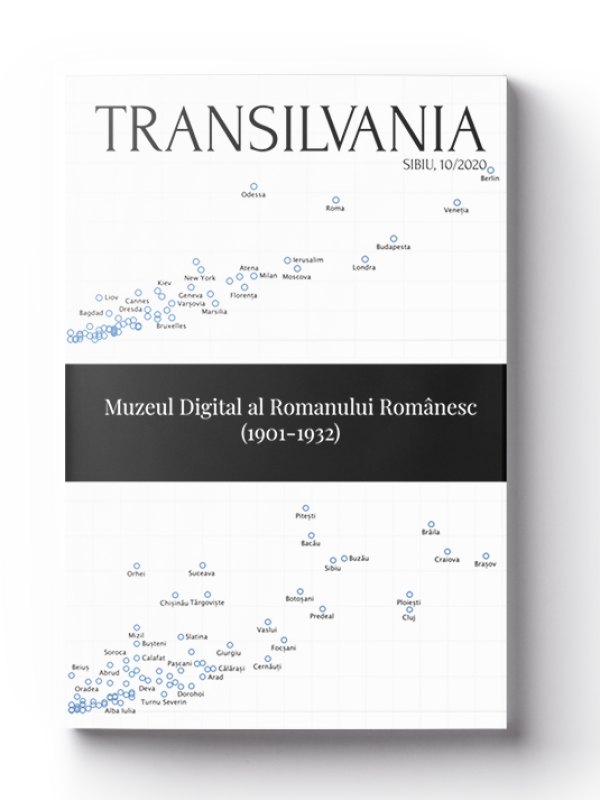
The Geography of the Romanian Novel (1901-1932): Spaces from Abroad

This article charts the main cities mentioned in the Romanian novel published between 1901 and 1932 based on the corpus of novels created by the research project The Digital Museum of the Romanian Novel 1901-1932 (around 370 digitized novels). The main discoveries that our distant reading of the geography in these novels revealed are that the
planet is covered in the Romanian novel during the period in genre fiction (that has mentions of cities from Africa, Asia and South America), not in modernist highbrow literature, and that the dominance of Paris and Rome as spaces where the action takes place is atomized during this period by smaller cities in France and Italy. The article also
describes the relation between social mobility and geographical coverage in the epoch.

Keywords: Romanian literature, distant reading, geocriticism, literary geography, planetarity.

Algee-Hewitt, Mark et al. “Canon/Archive. Large-scale Dynamics in the Literary Field.” In Canon/Archive, edited by Franco Moretti, 253-294. New York: N+1 Foundation, 2017.
Baghiu, Ștefan, Vlad Pojoga, Cosmin Borza, Andreea Coroian Goldiș, Daiana Gârdan, Emanuel Modoc, David Morariu, Teodora Susarenco, Radu Vancu, and Dragoș Varga. Muzeul Digital al Romanului Românesc: secolul al XIX-lea [The Digital Museum of
the Romanian Novel: The 19th Century]. Sibiu: Complexul Național Muzeal ASTRA, 2019. https://new.revistatransilvania.ro/mdrr. Accessed November 15, 2020. (MDRR)
Baghiu, Ștefan, Vlad Pojoga, Cosmin Borza, Andreea Coroian Goldiș, Denisa Frătean, Daiana Gârdan, Alex Goldiș, Emanuel Modoc, Iunis Minculete, David Morariu, Ovio Olaru, Teodora Susarenco, Andrei Terian, Radu Vancu, and Dragoș Varga.
Muzeul Digital al Romanului Românesc: 1901-1932 [The Digital Museum of the Romanian Novel: 1901-1932]. Sibiu: Complexul Național Muzeal ASTRA, 2020. https://new.revistatransilvania.ro/mdrr1901-1932. Available December 15, 2020. (MDRR2)
Baghiu, Ștefan, Vlad Pojoga, Teodora Susarenco, Radu Vancu, and Emanuel Modoc. “Geografia internă a romanului românesc în secolul al XIX-lea” [The Internal Geogpraphy of the Romanian Novel in the 19th Century]. Transilvania, no. 10 (2019): 29-43.
Ban, Cornel. Dependență și dezvoltare. Economia politică a capitalismului românesc [Dependency and Development. The Political Economy of Romanian Capitalism]. Cluj-Napoca: Tact, 2014.
Conkan, Marius and Daiana Gârdan. “Space in Literature and Literature in Space.” Metacritic Journal for Comparative Studies and Theory 6, no. 1 (2020). https://doi.org/10.24193/mjcst.2020.9.01.
Coroian-Goldiș, Andreea, Daiana Gârdan, Emanuel Modoc, Teodora Susarenco, David Morariu, and Cosmin Borza. “Arhivele romanului românesc și posibilități de digitizare” [The Archives of the Romanian Novel and Digitization Possibilities]. Transilvania, no. 10 (2019): 1-8.
Goldiș, Alex. “Beyond Nation Building: Literary History as Transnational Geolocation.” In Romanian Literature as World Literature, edited by Mircea Martin, Christian Moraru, and Andrei Terian, 95-115. New York: Bloomsbury, 2018).
Goldiș, Alex, Cosmin Borza, Daiana Gârdan, Emanuel Modoc, Dragoș Varga, and David Morariu. “Poli de producție ai romanului românesc (1901-1932)” [Production Centers of the Romanian Novel (1901-1932): Editorial Networks and Canonization Process]. Transilvania, no. (2020): 45-52.
Martin, Mircea, Christian Moraru, and Andrei Terian, eds. Romanian Literature as World Literature. New York: Bloomsbury, 2018.
Modoc, Emanuel, Daiana Gârdan, Ștefan Baghiu, Andreea Coroian-Goldiș, Radu Vancu, and Vlad Pojoga. “Geografia romanului românesc (1901-1932): arealul național” [The Geography of the Romanian Novel (1901-1932): The National Areal]. Transilvania,
no. 10 (2020): 12-21.
Modoc, Emanuel. Internaționala periferiilor [The Peripheries’ International]. Bucharest: Muzeul Național al Literaturii Române, 2019.
Moraru, Christian. Reading for the Planet. Toward a Geomethodology. Ann Arbor: University of Michigan Press, 2015.
Moretti, Franco. Atlas of the European Novel 1800-1900. New York: Verso, 1998.
Patraș, Roxana, Ioana Galleron, Camelia Grădinaru, Ioana Lionte, and Lucreția Pascaru. “The Splendors and Mist(eries) of Romanian Digital Literary Studies: a State-of-the-Art just before Horizons 2020 closes off.” Hermeneia, no. 23 (2019): 207-222.
Patras, Roxana. Romanian Novel Corpus (ELTeC-rom): Release with 80 novels encoded at level 1. (Version v0.7.0) [Data set].
Zenodo (2020). In European Literary Text Collection (ELTeC), version 1.0.0, November 2020, edited by Carolin Odebrecht, Lou Burnard and Christof Schöch. COST Action Distant Reading for European Literary History (CA16204). DOI: doi.org/10.5281/
zenodo.4274954.
Pojoga, Vlad, Daiana Gârdan, Ștefan Baghiu, Cosmin Borza, Iunis Minculete, and Denisa Frătean. “Diversitate identitară în romanul românesc (1844-1932)” [Identity and Diversity in the Romanian Novel (1844-1932)]. Transilvania, no. 10 (2020): 33-44.
Pojoga, Vlad, Ștefan Baghiu, Emanuel Modoc, Daian Gârdan, and Andreea Coroian Goldiș. “Tehnici digitale pentru analiza romanului românesc” [Digital Tools for the Analysis of the Romanian Novel], Transilvania, no. 10 (2019): 9-16.
Tally Jr., Robert T. ed. Geocritical Explorations: Space, Place, and Mapping in Literary and Cultural Studies. New York: Palgrave Macmillan, 2011.
Terian, Andrei, Daiana Gârdan, Cosmin Borza, David Morariu, and Dragoș Varga. “Genurile romanului românesc în secolul al XIX-lea. O analiză cantitativă.” [The Genres of the Romanian Novel in the 19th Century] Revista Transilvania, no. 10 (2019): 17-28.
Terian, Andrei, Daiana Gârdan, Emanuel Modoc, Cosmin Borza, Dragoș Varga, Ovio Olaru, and David Morariu. „Genurile romanului românesc (1901-1932). O analiză cantitativă” [“The Genres of the Romanian Novel (1901-1932). A Quantitative Analysis”]. Transilvania, no. 10 (2020): 53-64.
Terian, Andrei. “Big Numbers: A Quantitative Analysis of the Development of the Novel in Romania,” Transylvanian Review, vol. XXVIII, Supplement no. 1 (2019): 55-71.
Vancu, Radu, Alex Goldiș, Ovio Olaru, Vlad Pojoga, Teodora Susarenco, Denisa Frătean, and Ștefan Baghiu. „Temporalitatea internă a romanului românesc (1844-1932).” Transilvania, no. 10 (2020): 22-32.
Vianu, Tudor. Arta prozatorilor români [The Art of Romanian Prose Writers] București: Minerva, 1988.
Westphal, Bertrand. The Plausible World. A Geocritical Approach to Space, Place, and Maps. New York: Palgrave Macmillan, 2013.
WReC. Combined and Uneven Development. Towards a New Theory of World-Literature. Liverpool: Liverpool University Press, 2015.

Autor: Emanuel MODOC, Daiana GÂRDAN, Ștefan BAGHIU, Andreea COROIAN-GOLDIȘ, Radu VANCU, Vlad POJOGA
Email: ermodoc@gmail.com

The Geography of the Romanian Novel (1901-1932): The National Areal

This article is part of a series that investigates through quantitative and geocritical means the corpus of novels created by the research project Astra Data Mining. The Digital Museum of the Romanian Novel 1901-1932 (around 370 novels digitized). One of the many foci of our analyses delves into the internal geography of the Romanian novel as it manifests itself through geolocated metadata that reveal the spatial diversity of the corpus, concerning not only plot setting, but also relating to the main topographical nodes underpinning the novelists’ consciousness. Because of such geolocational diversity, the following study will only deal with the national setting of the Romanian novel.

Keywords: romanian novel, literary geography, literary cartography, geocriticism, urban development and literature.

Baghiu, Ștefan, Andrei Terian, Vlad Pojoga, Teodora Susarenco, Iunis Minculete, and Ovio Olaru. “Geografia romanului românesc (1901-1932): străinătatea”, în Transilvania no. 10 (2020): 1-11.
Baghiu, Ștefan, Vlad Pojoga, Teodora Susarenco, Radu Vancu, and Emanuel Modoc. “Geografia internă a romanului românesc în secolul al XIX-lea.” Transilvania, no. 10 (2019): 29-43.
Baghiu, Ștefan, Vlad Pojoga, Cosmin Borza, Andreea Coroian Goldiș, Daiana Gârdan, Emanuel Modoc, David Morariu, Teodora Susarenco, Radu Vancu, and Dragoș Varga. Muzeul Digital al Romanului Românesc: secolul al XIX-lea [The Digital Museum of the Romanian Novel: The 19th Century]. Sibiu: Complexul Național Muzeal ASTRA, 2019. https://new.revistatransilvania.ro/mdrr. Accessed November 15, 2020.
Baghiu, Ștefan, Vlad Pojoga, Cosmin Borza, Andreea Coroian Goldiș, Denisa Frătean, Daiana Gârdan, Alex Goldiș, Emanuel Modoc, Iunis Minculete, David Morariu, Ovio Olaru, Teodora Susarenco, Andrei Terian, Radu Vancu, and Dragoș Varga.
Muzeul Digital al Romanului Românesc: 1901-1932 [The Digital Museum of the Romanian Novel: 1901-1932]. Sibiu: Complexul Național Muzeal ASTRA, 2020. https://new.revistatransilvania.ro/mdrr1901-1932. Available December 15, 2020.
Ban, Cornel. “Beyond anticommunism: The fragility of class analysis in Romania.” East European Politics and Societies 29, no. 3 (2015): 640-650.
Ban, Cornel. Dependență și dezvoltare. Economia politică a capitalismului românesc [Dependency and Development. The Political Economy of Romanian Capitalism]. Cluj-Napoca: Tact, 2014.
Boatcă, Manuela. “Second Slavery versus Second Serfdom: Local Labor Regimes of the Global Periphery.” In Social Theory and Regional Studies in the Global Age, edited by Saïd Amir Arjomand, 361-389. New York: Suny Press, 2014.
Borza, Cosmin. “How to Populate a Country. A Quantitative Analysis of the Rural Novel from Romania (1901-2000).” In Ruralism and Literature in Romania, edited by Ștefan Baghiu, Vlad Pojoga, Maria Sass, 21-40. Berlin: Peter Lang, 2019.
Cornis-Pope, Marcel și John Neubauer (eds.). History of the Literary Cultures of East-Central Europe. Junctures and Disjunctures in the 19th and 20th Centuries, vol. I-IV. Amsterdam: John Benjamins, 2004-2010.
Coroian-Goldiș, Andreea, Daiana Gârdan, Emanuel Modoc, Teodora Susarenco, David Morariu, and Cosmin Borza. “Arhivele romanului românesc și posibilități de digitizare” [The Archives of the Romanian Novel and Digitization Possibilities]. Transilvania, no. 10 (2019): 1-8.
Dobrogeanu-Gherea, Constantin. Neoiobăgia. Studiu economic-sociologic al problemei noastre agrare [Neo-Serfdom]. Bucharest: Socec, 1910.
Gârdan, Daiana. “Interstitial Spatiality in the Romanian Novel of the Interwar Period: Mute Rurality and Subverted Urbanity.” In Ruralism and Literature in Romania, edited by Ștefan Baghiu, Vlad Pojoga, and Maria Sass, 69-80. Berlin: Peter Lang, 2019, 69-80.
Goldiș, Alex, Cosmin Borza, Daiana Gârdan, Emanuel Modoc, Dragoș Varga, and David Morariu. “Poli de producție ai romanului românesc (1901-1932)” [Production Centers of the Romanian Novel (1901-1932): Editorial Networks and Canonization Process]. Transilvania, no. 10 (2020): 45-52.
Guga, Ștefan. Sociologia istorică a lui Henri H. Stahl [The Historical Sociology of Henri H. Stahl]. Cluj-Napoca: Tact, 2015.
Lovinescu, Eugen. Istoria literaturii române contemporane [The History of Contemporary Romanian Literaturer], vol. 2. Bucharest: Minerva, București, 1973.
Martin, Mircea, Christian Moraru, and Andrei Terian. Romanian Literature as World Literature. New York: Bloomsbury, 2018.
Moraru, Christian. Reading for the Planet. Toward a Geomethodology. Ann Arbor: University of Michigan Press, 2015.
Moretti, Franco, ed. The Novel. Volume I. History, Geography and Culture. Princeton and Oxford: Princeton University Press, 2006.
Moretti, Franco. Atlas of the European Novel 1800-1900. London: Verso, 1998.
Patras, Roxana. Romanian Novel Corpus (ELTeC-rom): Release with 80 novels encoded at level 1. (Version v0.7.0) [Data set]. Zenodo (2020). In European Literary Text Collection (ELTeC), version 1.0.0, November 2020, edited by Carolin Odebrecht, Lou
Burnard and Christof Schöch. COST Action Distant Reading for European Literary History (CA16204). DOI: doi.org/10.5281/zenodo.4274954.
Patraș, Roxana, Ioana Galleron, Camelia Grădinaru, Ioana Lionte, and Lucreția Pascaru. “The Splendors and Mist(eries) of Romanian Digital Literary Studies: a State-of-the-Art just before Horizons 2020 closes off.” Hermeneia, no. 23 (2019): 207-222.
Pojoga, Vlad, Daiana Gârdan, Ștefan Baghiu, Cosmin Borza, Iunis Minculete, and Denisa Frătean. “Diversitate identitară în romanul românesc (1844-1932)” [Diversity of Identity in the Romanian Novel (1844-1932)]. Transilvania no. 10 (2020): 33-44.
Pojoga, Vlad, Ștefan Baghiu, Emanuel Modoc, Daian Gârdan, and Andreea Coroian Goldiș. “Tehnici digitale pentru analiza romanului românesc” [Digital Tools for the Analysis of the Romanian Novel], Transilvania, no. 10 (2019): 9-16.
Radu, Sorin, Oliver Jens Schmitt. Politics and Peasants in Interwar Romania: Perceptions, Mentalities, Propaganda. Cambridge Scholars Publishing: 2017.
Rostás, Zoltan. “Monografia Drăgușului și contextul ei” [The Drăguș Monograph and its Context]. Transilvania, no. 2-3 (2020): 4-9.
Sdrobiș, Dragoș. “From Science to Action: Professionalizing Social Work in Greater Romania.” In Ruralism and Literature in Romania, edited by Ștefan Baghiu, Vlad Pojoga, Maria Sass, 219-249. Berlin: Peter Lang, 2019.
Simion Cosma, Valer. “Inventing the Romanian Peasant in Transylvania during the Nineteenth Century.” In Ruralism and Literature in Romania, edited by Ștefan Baghiu, Vlad Pojoga, Maria Sass, 165-191. Berlin: Peter Lang, 2019.
Terian, Andrei. “Big Numbers: A Quantitative Analysis of the Development of the Novel in Romania.” Transylvanian Review, vol. XXVIII, Supplement no. 1 (2019): 55-71.
Terian, Andrei, Daiana Gârdan, Cosmin Borza, David Morariu, and Dragoș Varga. „Genurile romanului românesc în secolul al XIX-lea. O analiză cantitativă.” Transilvania, no. 10 (2019): 17-28.
Terian, Andrei, Daiana Gârdan, Emanuel Modoc, Cosmin Borza, Dragoș Varga, Ovio Olaru, and David Morariu, “Genurile romanului românesc (1901-1932). O analiză cantitativă” [Genres of the Romanian Novel (1901-1932). A Quantitative Analysis].
Transilvania n0. 10 (2020): 53-64.
Thacker, Andrew. “The Idea of a Critical Literary Geography.” New Formations 57 (2005): 56-73.
Vancu, Radu, Alex Goldiș, Ovio Olaru, Vlad Pojoga, Teodora Susarenco, Denisa Frătean, and Ștefan Baghiu, “Temporalitatea internă a romanului românesc (1844-1932)” [The Internal Temporaity of the Romanian Novel (1844-1932)], Transilvania, no. 10
(2020): 22-32.
Zamfir, Mihai. Scurtă istorie. Panorama alternativă a literaturii române. Bucharest: Cartea Românească, 2011.

Autor: Radu VANCU, Alex GOLDIȘ, Ovio OLARU, Vlad POJOGA, Teodora SUSARENCO, Denisa FRĂTEAN, Ștefan BAGHIU
Email: rvancu@gmail.com

The Internal Temporality of the Romanian Novel (1844-1932)

The present article follows the relationship of the Romanian novelistic output between 1901 and 1932 with time and temporal distribution. Its emphasis falls on the degree of correlation between the time of publication and the time during which the events unfold for each corresponding novel, expressed through a variable coined “distance”. By making use of this variable, the temporal distribution of the novelistic corpus in the article clearly shows that the novelists’ focus gradually shifts towards contemporary events; while during the period between 1900 up until the outbreak of World War One, novelists were inclined to place the events of their works in the past, the War seems to have triggered an acute preoccupation with the immediate present. Lastly, the text touches upon two distinct
subgenres of the novel, arisen out of their relationship to time, namely the historical novel and the so-called ‘contemporary novel’.

Keywords: Romanian literature, time in literature, narrative and time, historical novel.

Anderson, Benedict. Imagined Communities: Reflections on the Origin and Spread of Nationalism. London: Verso, 2016.
Baghiu, Ștefan, Andrei Terian, Vlad Pojoga, Teodora Susarenco, Iunis Minculete, and Ovio Olaru. “Geografia romanului românesc (1901-1932): străinătatea” [The Geogpraphy of the Romanian Novel (1901-1932): Spaces from Abroad]. Transilvania, no. 10 (2020): 1-11.
Baghiu, Ștefan, Vlad Pojoga, Cosmin Borza, Andreea Coroian Goldiș, Daiana Gârdan, Emanuel Modoc, David Morariu, Teodora Susarenco, Radu Vancu, and Dragoș Varga. Muzeul Digital al Romanului Românesc: secolul al XIX-lea [The Digital Museum of TRANSILVANIA 10/2020 the Romanian Novel: The 19th Century]. Sibiu: Complexul Național Muzeal ASTRA, 2019. https://new.revistatransilvania.ro/mdrr. Accessed November 15, 2020.
Baghiu, Ștefan, Vlad Pojoga, Cosmin Borza, Andreea Coroian Goldiș, Denisa Frătean, Daiana Gârdan, Alex Goldiș, Emanuel Modoc, Iunis Minculete, David Morariu, Ovio Olaru, Teodora Susarenco, Andrei Terian, Radu Vancu, and Dragoș Varga. Muzeul Digital
al Romanului Românesc: 1901-1932 [The Digital Museum of the Romanian Novel: 1901-1932]. Sibiu: Complexul Național Muzeal ASTRA, 2020. https://new.revistatransilvania.ro/mdrr1901-1932. Available December 15, 2020.
Baghiu, Ștefan, Vlad Pojoga, Teodora Susarenco, Radu Vancu, and Emanuel Modoc. “Geografia internă a romanului românesc în secolul al XIX-lea” [The Internal Geogpraphy of the Romanian Novel in the 19th Century]. Transilvania, no. 10 (2019): 29-43.
Coroian-Goldiș, Andreea, Daiana Gârdan, Emanuel Modoc, Teodora Susarenco, David Morariu, Cosmin Borza. “Arhivele romanului românesc și posibilități de digitizare” [The Archives of the Romanian Novel and Digitization Possibilities]. Transilvania, no. 10 (2019): 1-8.
Currie, Mark. About Time. Narrative, Fiction and the Philosophy of Time. Edinburgh: Edinburgh University Press, 2007.
Frank, Joseph. The Idea of Spatial Form. London: Rutgers University Press, 1991.
Goldiș, Alex, Cosmin Borza, Daiana Gârdan, Emanuel Modoc, Dragoș Varga, and David Morariu. “Poli de producție ai romanului românesc (1901-1932)” [Production Centers of the Romanian Novel (1901-1932): Editorial Networks and Canonization Process]. Transilvania, no. (2020): 45-52.
Harvey, David. Condiția postmodernității: o cercetare asupra originilor schimbării culturale [The Condition of Postmodernity]. Translated by Cristina Gyurcsik. Timișoara: Amarcord, 2012 [1989].
Hobsbawn, Eric. The Age of Capital 1848-1875; The Age of Empire 1875-1914; The Age of Revolution 1789-1848. London: Orion, 2010.
Lukács, Georg. The Historical Novel. Londra: Merlin Press, 1962.
Modoc, Emanuel, Daiana Gârdan, Ștefan Baghiu, Andreea Coroian-Goldiș, Radu Vancu, Vlad Pojoga. “Geografia internă a romanului românesc (1901-1932): Arealul național” [The Internal Geography of the Romanian Novel (1901-1932): The National
Areal]. Transilvania, no. 10 (2020): 12-21.
Patras, Roxana. Romanian Novel Corpus (ELTeC-rom): Release with 80 novels encoded at level 1. (Version v0.7.0) [Data set]. Zenodo (2020). In European Literary Text Collection (ELTeC), version 1.0.0, November 2020, edited by Carolin Odebrecht, Lou Burnard and
Christof Schöch. COST Action Distant Reading for European Literary History (CA16204). DOI: doi.org/10.5281/zenodo.4274954.
Patraș, Roxana, Ioana Galleron, Camelia Grădinaru, Ioana Lionte, Lucreția Pascaru. “The Splendors and Mist(eries) of Romanian Digital Literary Studies: a State-of-the-Art just before Horizons 2020 closes off.” Hermeneia, no. 23 (2019): 207-222.
Pojoga, Vlad, Daiana Gârdan, Ștefan Baghiu, Cosmin Borza, Iunis Minculete, and Denisa Frătean. “Diversitatea identitară în romanul românesc (1844-1932)” [Identity and Diversity in the Romanian Novel (1844-1932)]. Transilvania, no. 10 (2020): 33-44.
Pojoga, Vlad, Ștefan Baghiu, Emanuel Modoc, Daian Gârdan, and Andreea Coroian Goldiș. “Tehnici digitale pentru analiza romanului românesc” [Digital Tools for the Analysis of the Romanian Novel]. Transilvania, no. 10 (2019): 9-16.
Ralea, Mihai D. “De ce nu avem roman” [Why We Don’t Have Novels]. Viața românească, no. 4 (1927): 82.
Ricoeur, Paul. Temps et récit. 3. Le Temps raconté. Paris: Éditions du Seuil, 1985.
Terian, Andrei, Daiana Gârdan, Cosmin Borza, David Morariu, and Dragoș Varga. “Genurile romanului românesc în secolul al XIX-lea. O analiză cantitativă.” [The Genres of the Romanian Novel in the 19th Century] Revista Transilvania, nr. 10 (2019): 17-28.
Terian, Andrei, Daiana Gârdan, Emanuel Modoc, Cosmin Borza, Dragoș Varga, Ovio Olaru, David Morariu. “Genurile romanului românesc (1901-1932). O analiză cantitativă” [The Genres of the Romanian Novel (1901-1932). A Quantitative Analysis].
Transilvania, no. 10 (2020): 53-64.
Terian, Andrei. “Big Numbers: A Quantitative Analysis of the Development of the Novel in Romania,” Transylvanian Review, vol. XXVIII, Supplement no. 1 (2019): 55-71.
Vianu, Tudor. Arta prozatorilor români [The Art of Romanian Prose Writers] București: Minerva, 1988.
White, Hayden. Metahistory: The Historical Imagination in Nineteenth-Century Europe. Baltimore: Johns Hopkins University Press, 1973.

Autor: Vlad POJOGA, Daiana GÂRDAN, Ștefan BAGHIU, Cosmin BORZA, Iunis MINCULETE, Denisa FRĂTEAN
Email: vlad.pojoga@ulbsibiu.ro

Diversity and Identity in the Romanian Novel (1844-1932)

This study explores, using intersectionality and quantitative analysis, several axes that help shape the identity of the characters in the fictional worlds from a corpus of approximately 500 Romanian novels published between 1844 and 1932. They are gender, ethnicity/nationality, and class/work. It also briefly analyzes the gender gap in the production of the novel and examines the dynamics between the gender of the authors and the gender of the main character(s) and the person of the narration, by using metadata compiled by our research team and complex searches in the digital corpus.

Keywords: Romanian literature, Romanian novel, axes of identity, intersectional analysis, quantitative analysis.

Baghiu, Ștefan, Andrei Terian, Vlad Pojoga, Teodora Susarenco, Iunis Minculete, and Ovio Olaru. “Geografia romanului românesc (1901-1932): străinătatea” [The Geogpraphy of the Romanian Novel (1901-1932): Spaces from Abroad]. Transilvania, no. 10 (2020): 1-11.
Baghiu, Ștefan, Vlad Pojoga, Cosmin Borza, Andreea Coroian Goldiș, Daiana Gârdan, Emanuel Modoc, David Morariu, Teodora Susarenco, Radu Vancu, and Dragoș Varga. Muzeul Digital al Romanului Românesc: secolul al XIX-lea [The Digital Museum of
the Romanian Novel: The 19th Century]. Sibiu: Complexul Național Muzeal ASTRA, 2019. https://new.revistatransilvania.ro/mdrr. Accessed November 15, 2020.
Baghiu, Ștefan, Vlad Pojoga, Cosmin Borza, Andreea Coroian Goldiș, Denisa Frătean, Daiana Gârdan, Alex Goldiș, Emanuel Modoc, Iunis Minculete, David Morariu, Ovio Olaru, Teodora Susarenco, Andrei Terian, Radu Vancu, and Dragoș Varga.
Muzeul Digital al Romanului Românesc: 1901-1932 [The Digital Museum of the Romanian Novel: 1901-1932]. Sibiu: Complexul Național Muzeal ASTRA, 2020. https://new.revistatransilvania.ro/mdrr1901-1932. Available December 15, 2020.
Baghiu, Ștefan, Vlad Pojoga, Teodora Susarenco, Radu Vancu, Emanuel Modoc, “Geografia internă a romanului românesc în secolul al XIX-lea” [The Internal Geography of the Romanian Novel in the 19th Century]. Transilvania, no. 10 (2019): 29-43.
Bal, Mieke. Narratology. Introduction to the Theory of Narrative. Toronto: University of Toronto Press, 2017.
Boatcă, Manuela, Anca Parvulescu. “Creolizing Transylvania: Notes on Coloniality and Inter-imperiality.” History of the Present 10, no.1 (2020). 9-27.
Borza, Cosmin. “How to Populate a Country. A Quantitative Analysis of the Rural Novel from Romania (1901-2000).” In Ruralism and Literature in Romania, edited by Ștefan Baghiu, Vlad Pojoga, and Maria Sass, 21-40. Berlin: Peter Lang, 2019.
Bucur, Maria. Eugenics and Modernization in Interwar Romania. Pittsburgh: University of Pittsburgh Press, 2002.
Bucur, Maria. Eugenie și modernizare în România interbelică [Eugenics and Modernization in Interwar Romania]. Iași: Polirom, 2005.
Bucur, Maria. Gender and War in Twentieth-Century Eastern Europe. Bloomington: Indiana University Press, 2006.
Burța-Cernat, Bianca. Fotografie de grup cu scriitoare uitate. Proza feminină interbelică [Group Photo with Forgoten Female Writers. Interwar Feminine Prose]. Bucharest: Cartea Românească, 2011.
Dorobanțu, Oana, and Carmen Gheorghe, ed. Problema Românească – O analiză a rasismului românesc [The Romanian Problem – An Analysis of Romanian Racism]. București: Hecate, 2019).
Dragomir, Sylvius. The Ethnical Minorities in Transylvania. Geneva: Sonor Printing Co, 1927. http://dspace.bcucluj.ro/
bitstream/123456789/85439/1/BCUCLUJ_FG_388065_1927.pdf. Accessed November 15.
Eriksen, Thomas Hylland. Ethnicity and Nationalism: Anthropological Perspectives. Second Edition. London: Pluto Press, 2010.
Gârdan, Daiana. “Interstitial Spatiality in the Romanian Novel in the Interwar Period: Mute Rurality and Subverted Urbanity.” In Ruralism and Literature in Romania, edited by Ștefan Baghiu, Vlad Pojoga, and Maria Sass, 69-81. Berlin: Peter Lang, 2019.
Gârdan, Daiana. “The Great Female Unread. Romanian Women Novelists in the First Half of the Twentieth Century: A Quantitative Approach.” Metacritic Journal for Comparative Studies and Theory, vol. 4, no. 1 (2018): 109-124.
Goldiș, Alex, Cosmin Borza, Daiana Gârdan, Emanuel Modoc, Dragoș Varga, and David Morariu. “Poli de producție ai romanului românesc (1901-1932)” [Production Centers of the Romanian Novel (1901-1932): Editorial Networks and Canonization Process]. Transilvania, no. 10 (2020): 45-52.
Heyes, Cressida. „Identity Politics.” The Stanford Encyclopedia of Philosophy (Fall 2020 Edition), edited by Edward N. Zalta.
https://plato.stanford.edu/archives/fall2020/entries/identity-politics/.
Hill Collins, Patricia, and Sirma Bilge. Intersectionality. Cambridge, UK: Polity Press, 2016.
Kóczé, Angéla ,Violetta Zentai, Jelena Jovanović, and Enikő Vincze, ed. The Romani Women’s Movement: Struggles and Debates in Central and Eastern Europe. New York: Routledge, 2018.
Margolin, Uri. “Narrator.” In The Living Handbook of Narratology, edited by Peter Hühn (Hamburg University). http://www.lhn.uni-hamburg.de/article/narrator. Accessed November 15.
Mihăilescu, Ștefania. Din istoria feminismului românesc. Antologie de texte (1838-1929) [From the History of Romanian Feminism. Texts Anthology (1838-1929)]. Iași: Polirom, 2002.
Miroiu, Mihaela, and Maria Bucur. Nașterea cetățeniei democratice: femeile și puterea în România modernă [Birth of Democratic Citizenship: Women and Power in Modern Romania]. Bucharest: Humanitas, 2019.
Modoc, Emanuel, Daiana Gârdan, Ștefan Baghiu, Andreea Coroian-Goldiș, Radu Vancu, and Vlad Pojoga. “Geografia romanului românesc (1901-1932): arealul național” [The Geography of the Romanian Novel (1901-1932): The National Areal]. Transilvania,
no. 10 (2020): 12-21.
Moretti, Franco. Distant Reading. London: Verso, 2013.
Negoițescu, I. Istoria literaturii române, vol. I [The History of Romanian Literature]. Bucharest: Minerva, 1991.
Parvulescu, Anca, and Manuela Boatcă. “The Inter-Imperial Dowry Plot.” Interventions. DOI: 10.1080/1369801X.2020.1762693
Parvulescu, Anca, and Manuela Boatcă. “(Dis)Counting Languages: Between Hugo Meltzl and Liviu Rebreanu.” Journal of World Literature 5, no.1 (2020): 47-78.
Parvulescu, Anca, and Manuela Boatcă. “The longue durée of Enslavement: Extracting Labor from Romani Music in Liviu Rebreanu’s Ion.” Literature Compass 17, no.1-2 (2020). Accessed November 15, 2020: https://doi.org/10.1111/lic3.12559.
Patraș, Roxana, Ioana Galleron, Camelia Grădinaru, Ioana Lionte, and Lucreția Pascaru. “The Splendors and Mist(eries) of Romanian Digital Literary Studies: a State-of-the-Art just before Horizons 2020 closes off.” Hermeneia, no. 23 (2019): 207-222.
Patraș, Roxana. “Hadjuk Novels in the Nineteenth-Century Romanian Fiction: Notes on a Sub-genre.” Swedish Journal of Romanian Studies II, no. 1 (2019).
Patras, Roxana. Romanian Novel Corpus (ELTeC-rom): Release with 80 novels encoded at level 1. (Version v0.7.0) [Data set]. Zenodo (2020). In European Literary Text Collection (ELTeC), version 1.0.0, November 2020, edited by Carolin Odebrecht, Lou
Burnard and Christof Schöch. COST Action Distant Reading for European Literary History (CA16204). DOI: doi.org/10.5281/zenodo.4274954.
Pavel, Dora. “Care e prima doamnă din literatura română?” [Who is the First Lady in Romanian Literature]. Apostrof 37, no. 6 (1993).
Pojoga, Vlad, Ștefan Baghiu, Emanuel Modoc, Daian Gârdan, and Andreea Coroian Goldiș. “Tehnici digitale pentru analiza romanului românesc” [Digital Tools for the Analysis of the Romanian Novel], Transilvania, nr. 10 (2019): 9-16.
Pyrah, Robert, and Marius Turda, ed. Re-Contextualising East Central European History: Nation, Culture and Minority Groups. New York: Legenda, 2010.
Radu, Sorin, and Oliver Jens Schmitt. Politics and Peasants in Interwar Romania: Perceptions, Mentalities, Propaganda. Newcastle: Cambridge Scholars Publishing: 2017.
Sdrobiș, Dragoș. “From Science to Action: Professionalizing Social Work in Greater Romania.” In Ruralism and Literature in Romania, edited by Ștefan Baghiu, Vlad Pojoga, Maria Sass, 219-249. Berlin: Peter Lang, 2019.
Simion Cosma, Valer. “Inventing the Romanian Peasant in Transylvania during the Nineteenth Century.” In Ruralism and TRANSILVANIA 10/2020 Acest articol a apărut în cadrul proiectului Muzeul Digital al Romanului Românesc 1900-1932, organizat de Complexul Național Muzeal ASTRA și co-finanțat de Administrația Fondului Cultural Național. Proiectul nu reprezintă în mod necesar poziția Administrației Fondului
Cultural Național. AFCN nu este responsabilă de conținutul proiectului sau de modul în care rezultatele proiectului pot fi folosite. Acestea sunt în întregime responsabilitatea beneficiarului finanțării.
Literature in Romania, edited by Ștefan Baghiu, Vlad Pojoga, Maria Sass, 165-191. Berlin: Peter Lang, 2019.
Terian, Andrei, Daiana Gârdan, Cosmin Borza, David Morariu, and Dragoș Varga. “Genurile romanului românesc în secolul al XIX-lea. O analiză cantitativă” [Genres of the Romanian Novel in the 19th Century. A Quantitative Analysis]. Transilvania, no. 10 (2019): 17-28.
Terian, Andrei, Daiana Gârdan, Emanuel Modoc, Cosmin Borza, Dragoș Varga, and Ovio Olaru, David Morariu. “Genurile romanului românesc (1901-1932). O analiză cantitativă” [Genres of the Romanian Novel (1901-1932). A Quantitative Analysis].
Transilvania no. 10 (2020): 53-64.
Terian, Andrei. “Big Numbers: A Quantitative Analysis of the Development of the Novel in Romania.” Transylvanian Review, vol. XXVIII, Supplement no. 1 (2019): 55-71.
Tudurachi, Ligia. Grup sburător: trăitul și scrisul împreună în cenaclul lui E. Lovinescu [Sburător Group: Living and Writing Together in E. Lovinescu’s Cenacle]. Timișoara: Editura Universității de Vest, 2019.
Turda, Marius, and Paul Weindling, eds. Blood and Homeland: Eugenics and Racial Nationalism in Central and Southeast Europe, 1900–1940. Budapest: Central European University Press, 2007.
Turda, Marius. “The Nation as Object: Race, Blood, and Biopolitics in Interwar Romania.” Slavic Review 66, no. 3 (2007): 413-441.
Turda, Marius. Eugenism și antropologie rasială în România. 1874-1944 [Eugenism and Racial Anthropology in Romania. 1874-1944]. Bucharest: Cuvântul, 2018.
Turda, Marius. Modernism and Eugenics. Berlin: Springer, 2010.
Turda, Marius. The History of East-Central European Eugenics, 1900-1945: Sources and Commentaries. New York: Bloomsbury, 2015.
Vancu, Radu, Alex Goldiș, Ovio Olaru, Vlad Pojoga, Teodora Susarenco, Denisa Frătean, and Ștefan Baghiu, “Temporalitatea internă a romanului românesc (1844-1932)” [The Internal Temporaity of the Romanian Novel (1844-1932)], Transilvania, no. 10 (2020): 22-32.

Autor: Alex GOLDIȘ, Cosmin BORZA, Daiana GÂRDAN, Emanuel MODOC, David MORARIU, Dragoș VARGA
Email: al3xgoldis@gmail.com

Production Centers of the Romanian Novel (1901-1932):
Editorial Networks and Canonization Process

The following study employs a quantitative analysis of the Romanian novelistic production from the period 1901-1932. By using the literary corpus developed by the research project ASTRA Data Mining. The Digital Museum of the Romanian Novel 1901-1932, implemented by ASTRA National Museum Complex, this paper focuses on the secondary canonical writers (with their “b-sides and rarities”), the novelists’ origins, the abundance and the  geographical nodes of production, in order to investigate the dynamic relation between national cultural centers and their respective editorial networks, as well as the mechanisms of canonization within the Romanian novel of the period.

Keywords: Novelistic production, Romanian Novel, Romanian literature, Quantitative analysis, Literary cartography.

***. DCRR-1. Dicționarul cronologic al romanului românesc de la origini până la 1989 [The Chronological Dictionary of the Romanian Novel from Origins to 1989]. Cluj-Napoca: Academia Română, 2004.
Baghiu, Ștefan, Andrei Terian, Vlad Pojoga, Teodora Susarenco, Iunis Minculete, Ovio Olaru. “Geografia romanului românesc (1901-1932): străinătatea” [The Geogpraphy of the Romanian Novel (1901-1932): Spaces from Abroad]. Transilvania, no. 10
(2020): 1-11.
Baghiu, Ștefan, Vlad Pojoga, and Maria Sass, eds. Ruralism and Literature in Romania. Berlin: Peter Lang, 2019.
Baghiu, Ștefan, Vlad Pojoga, Teodora Susarenco, Radu Vancu, and Emanuel Modoc. “Geografia romanului românesc în secolul al XIX-lea” [The Internal Geogpraphy of the Romanian Novel in the 19th Century]. Transilvania, no. 10 (2019): 29-43.
Baghiu, Ștefan, Vlad Pojoga, Cosmin Borza, Andreea Coroian Goldiș, Daiana Gârdan, Emanuel Modoc, David Morariu, Teodora Susarenco, Radu Vancu, and Dragoș Varga. Muzeul Digital al Romanului Românesc: secolul al XIX-lea [The Digital Museum of the Romanian Novel: The 19th Century]. Sibiu: Complexul Național Muzeal ASTRA, 2019. https://new.revistatransilvania.ro/mdrr. Accessed November 15, 2020.
Baghiu, Ștefan, Vlad Pojoga, Cosmin Borza, Andreea Coroian Goldiș, Denisa Frătean, Daiana Gârdan, Alex Goldiș, Emanuel Modoc, Iunis Minculete, David Morariu, Ovio Olaru, Teodora Susarenco, Andrei Terian, Radu Vancu, and Dragoș Varga. Muzeul Digital al Romanului Românesc: 1901-1932 [The Digital Museum of the Romanian Novel: 1901-1932]. Sibiu: Complexul Național Muzeal ASTRA, 2020. https://new.revistatransilvania.ro/mdrr1901-1932. Available December 15, 2020.
Borza, Cosmin. “How to Populate a Country. A Quantitative Analysis of the Rural Novel from Romania (1901-2000).” In Ruralism and Literature in Romania, edited by Ștefan Baghiu, Vlad Pojoga, and Maria Sass, 21-40. Berlin: Peter Lang, 2019.
Cohen, Margaret. The Sentimental Education of the Novel. Princeton: Princeton University Press, 1999.
Coroian-Goldiș, Andreea, Daiana Gârdan, Emanuel Modoc, Teodora Susarenco, David Morariu, and Cosmin Borza. “Arhivele romanului românesc și posibilități de digitizare” [The Archives of the Romanian Novel and Digitization Possibilities]. Transilvania, no. 10 (2019): 1-8.
Damrosch, David. “World Literature in a Postcanonical, Hypercanonical Age.” In Comparative Literature in an Age of Globalization, edited by Haun Saussy, 45-53. Baltimore: The John Hopkins University Press, 2006.
Dragomirescu, Mihail. Sămănătorism, poporanism, criticism [Sămănătorism, Poporanism, Criticism]. Bucharest: Editura Institutului de literatură, 1934.
Dumitru, Teodora. “Social Class Difference and the Evolution of Romanian Literature from Lovinescuʼs. Perspective (1924-TRANSILVANIA 10/2020 1929).” In Ruralism and Literature in Romania, edited by Ștefan Baghiu, Vlad Pojoga, and Maria Sass, 205-219. Berlin: Peter
Lang, 2019.
Gârdan, Daiana. “Interstitial Spatiality in the Romanian Novel in the Interwar Period: Mute Rurality and Subverted Urbanity.” In Ruralism and Literature in Romania, edited by Ștefan Baghiu, Vlad Pojoga, and Maria Sass, 69-81. Berlin: Peter Lang, 2019.
Gârdan, Daiana. “The Great Female Unread. Romanian Women Novelists in the First Half of the Twentieth Century: A Quantitative Approach.” Metacritic Journal for Comparative Studies and Theory 4, no. 1 (2018): 109-124.
Iovănel, Mihai. “Mobile Frontiers: Instrumentations of Paraliterature in Modern Romanian Literature (1878-2018).” Transylvanian Review, XXVIII, Supplement no. 1 (2019): 73-82.
Iovănel, Mihai. “Peasants and Intelligent Machines.” In Ruralism and Literature in Romania, edited by Ștefan Baghiu, Vlad Pojoga, and Maria Sass, 117-128. Berlin: Peter Lang, 2019.
Lovinescu, E. Scrieri 4. Istoria literaturii române contemporane [The History of Romanian Contemporary Literature]. Bucharest: Minerva, 1973.
Modoc, Emanuel, Daiana Gârdan, Ștefan Baghiu, Andreea Coroian-Goldiș, Radu Vancu, and Vlad Pojoga. “Geografia romanului românesc (1901-1932): arealul național” [The Geography of the Romanian Novel (1901-1932): The National Areal]. Transilvania,
no. 10 (2020): 12-21.
Moretti, Franco. “The Slaughterhouse of Literature.” Modern Language Quarterly, vol. 61, no. 1 (2000): 207-227.
Patraș, Roxana. Romanian Novel Corpus (ELTeC-rom): Release with 80 novels encoded at level 1. (Version v0.7.0) [Data set]. Zenodo (2020). In European Literary Text Collection (ELTeC), version 1.0.0, November 2020, edited by Carolin Odebrecht, Lou
Burnard and Christof Schöch. COST Action Distant Reading for European Literary History (CA16204). DOI: doi.org/10.5281/zenodo.4274954.
Patraș, Roxana, Ioana Galleron, Camelia Grădinaru, Ioana Lionte, and Lucreția Pascaru. “The Splendors and Mist(eries) of Romanian Digital Literary Studies: a State-of-the-Art just before Horizons 2020 closes off.” Hermeneia, no. 23 (2019): 207-222.
Pojoga, Vlad, Daiana Gârdan, Ștefan Baghiu, Cosmin Borza, Iunis Minculete, and Denisa Frătean. “Diversitate identitară în romanul românesc (1844-1932)” [Identity and Diversity in the Romanian Novel (1844-1932)]. Transilvania, no. 10 (2020): 33-44.
Pojoga, Vlad, Ștefan Baghiu, Emanuel Modoc, Daian Gârdan, and Andreea Coroian Goldiș. “Tehnici digitale pentru analiza romanului românesc” [Digital Tools for the Analysis of the Romanian Novel], Transilvania, nr.10 (2019): 9-16.
Ralea, Mihai D. “De ce nu avem roman” [Why We Don’t Have Novels]. Viața românească, no. 4 (1927): 82.
Sasu, Aurel, ed. Dicționarul biografic al literaturii române, vol. I-II [Biographical Dictionary of Romanian Literature]. Pitești: Paralela 45, 2006.
Simion, Eugen, ed. Dicționarul general al literaturii române, vol. I-VII [General Dictionary of Romanian Literature]. Bucharest: Univers Enciclopedic, 2004-2009.
Simion, Eugen, ed. Dicționarul general al literaturii române. Ediția a II-a revizuită, adăugită și adusă la zi, vol. I-IV [General Dictionary of Romanian Literature]. Bucharest: Univers Enciclopedic, 2016-2017.
Terian, Andrei, Daiana Gârdan, Cosmin Borza, David Morariu, and Dragoș Varga. “Genurile romanului românesc în secolul al XIX-lea. O analiză cantitativă” [The Genres of the Romanian Novel in the 19th Century]. Transilvania, nr. 10 (2019): 17-28.
Terian, Andrei, Daiana Gârdan, Emanuel Modoc, Cosmin Borza, Dragoș Varga, Ovio Olaru, and David Morariu. “Genurile romanului românesc (1901-1932). O analiză cantitativă” [The Genres of the Romanian Novel (1901-1932). A Quantitative Analysis]. Transilvania, no. 10 (2020): 53-64.
Terian, Andrei. “Big Numbers: A Quantitative Analysis of the Development of the Novel in Romania,” Transylvanian Review, vol. XXVIII, Supplement no. 1 (2019): 55-71.
Vancu, Radu, Alex Goldiș, Ovio Olaru, Vlad Pojoga, Teodora Susarenco, Denisa Frătean, and Ștefan Baghiu, “Temporalitatea internă a romanului românesc (1844-1932)” [The Internal Temporaity of the Romanian Novel (1844-1932)], Transilvania, no. 10 (2020): 22-32.

Autor: Andrei TERIAN, Daiana GÂRDAN, Emanuel MODOC, Cosmin BORZA, Dragoș VARGA, Ovio OLARU, David MORARIU
Email: andrei.terian@ulbsibiu.ro

The Genres of the Romanian Novel 1901–1932: A Quantitative Analysis

Combining the instruments of quantitative analysis with those of genre theory, the present article studies the ratio, characteristics, and tendencies underpinning the most important subgenres of the Romanian novel between 1901 and 1932. Among these subgenres, we lay special emphasis on those of popular fiction, on the social, historical, sentimental, psychological, and philosophical novel, as well as on the so-called “event novel”. The conclusions of our inquiry illustrate the ever-growing divide between artistic literature and popular fiction, the recasting of the Romanian novelistic subgenres during the early 20th century, and the gradual relocation of the novelists’ focus from the unmediated depiction of events towards the world and the individual self.

Keywords: Romanian novel, (sub)genres, quantitative analysis, archive vs. canon

*** DCRR-1 – Dicționarul cronologic al romanului românesc de la origini până la 1989. [The Chronological Dictionary of the Romanian Novel from Origins to 1989] Cluj-Napoca: Academia Română, 2004.
Baghiu, Ștefan, Andrei Terian, Vlad Pojoga, Teodora Susarenco, Iunis Minculete, and Ovio Olaru. “Geografia romanului românesc (1901-1932): străinătatea” [The Geogpraphy of the Romanian Novel (1901-1932): Spaces from Abroad]. Transilvania, no. 10 (2020): 1-11.
Baghiu, Ștefan, Vlad Pojoga, Cosmin Borza, Andreea Coroian Goldiș, Daiana Gârdan, Emanuel Modoc, David Morariu, Teodora Susarenco, Radu Vancu, and Dragoș Varga. Muzeul Digital al Romanului Românesc: secolul al XIX-lea [The Digital Museum of the Romanian Novel: The 19th Century]. Sibiu: Complexul Național Muzeal ASTRA, 2019. https://new.revistatransilvania.ro/mdrr.
Baghiu, Ștefan, Vlad Pojoga, Cosmin Borza, Andreea Coroian Goldiș, Denisa Frătean, Daiana Gârdan, Alex Goldiș, Emanuel Modoc, Iunis Minculete, David Morariu, Ovio Olaru, Teodora Susarenco, Andrei Terian, Radu Vancu, and Dragoș Varga. Muzeul Digital al Romanului Românesc: 1901-1932 [The Digital Museum of the Romanian Novel: 1901-1932]. Sibiu: Complexul Național Muzeal ASTRA, 2020. https://new.revistatransilvania.ro/mdrr1901-1932.
Borza, Cosmin. “How to Populate a Country. A Quantitative Analysis of the Rural Novel from Romania (1900–2000)”. In Ruralism and Literature in Romania, edited by Ștefan Baghiu, Vlad Pojoga, Maria Sass, 21-40. Berlin, Peter Lang, 2019.
Borza, Cosmin. “Răscoala ca revoluție literară. 1907 în romanele românești interbelice și postbelice.” In Revolutions. The Archeology of Change, edited by Emanuel Grosu, Anca-Diana Bibiri, Camelia Grădinescu, Andreea Mironescu, and Roxana Patraș, 371-378. Iași: Editura Universității Alexandru Ioan Cuza, 2017.
Călinescu, G. Istoria literaturii române de la origini până în prezent [The History of Romanian Literature from Origins to the Present]. Ediția a doua, revăzută și adăugită. București: Minerva, 1982.
Cazamian, Louis. Le roman social en Angleterre (1830-1850). Paris: Société nouvelle de librairie et dʼédition, 1904.
Charles-Brun, Jean. Le roman social en France au XIXe siècle. Paris: V. Giard & E. Brière Libraires-Éditeurs, 1910.
Childers, Joseph W. “Industrial Culture and the Victorian Novel”. In The Cambridge Companion to the Victorian Novel, edited by Deirdre David, 77-96. Cambridge: Cambridge University Press, 2001.
Cioculescu, Șerban, Vladimir Streinu, and Tudor Vianu. Istoria literaturii române moderne [History of Modern Romanian Literature]. București: Eminescu, 1985.
Cohen, Margaret. The Sentimental Education of the Novel. Princeton: Princeton University Press, 1999.
Cornis-Pope, Marcel. “The Search for a Modern, Problematizing Historical Consciousness: Romanian Historical Fiction and Family Cycles.” In History of the Literary Cultures of East-Central Europe: Junctures and Disjunctures in the 19th and 20th Centures, Vol. I,
edited by Marcel Cornis-Pope and John Neubauer, 499-505. Amsterdam/Philadelphia: John Benjamins Publishing Co., 2004.
De Groot, Jerome. The Historical Novel. London/New York: Routledge, 2010.
TRANSILVANIA 10/2020
Drăgan, Ioana. Romanul popular în România. Literar și paraliterar [The Popular Novel in Romania. Literary and Paraliterary]. Cluj-Napoca: Casa Cărții de Știință, 2006.
Florea, Rodica. “Romanul sadovenian – social și de moravuri – până la primul război mondial” [Sadoveanu’s Social and Moral Novels Until the First World War]. Revista de istorie și teorie literară, nr. 4 (1970): 523‑536.
Fusillo, Massimo. “Aethiopika (Heliodorus, Third or Fourth Century).” In The Novel: Forms and Themes. vol. 2. edited by Franco Moretti, 131-137. Princeton: Princeton University Press, 2006.
Gârdan, Daiana. “Evoluția romanului erotic românesc din prima jumătate a secolului al XX-lea. Între exercițiu și canonizare” [The Evolution Of The Romanian Erotic Novel From The First Half Of The 20th Century. Between Exercise and Canonization]. Transilvania no. 7 (2018): 5-10.
Gârdan, Daiana. “The Great Female Unread. Romanian Women Novelists in the First Half of the Twentieth Century: A Quantitative Approach.” Metacritic Journal for Comparative Studies and Theory 4, no. 1 (2018): 109-124.
Gârdan, Daiana. “Tipologiile romanului românesc și provocările cercetării cantitative. Cazul romanului social și de moravuri” [The Typologies of the Romanian Novel and the Challenges of Quantitative Research]. Caietele Sextil Pușcariu 4 (2019): 418-427.
Goldiș, Alex, Cosmin Borza, Daiana Gârdan, Emanuel Modoc, Dragoș Varga, and David Morariu. “Poli de producție ai romanului românesc (1901-1932)” [Production Centers of the Romanian Novel (1901-1932): Editorial Networks and
Canonization Process]. Transilvania, no. 10 (2020): 45-52.
Huyssen, Andreas. After the Great Divide: Modernism, Mass Culture, Postmodernism. Bloomington: Indiana University Press, 1986.
Iovănel, Mihai. “Literatura polițistă [Detective Fiction]”. In Dicționarul general al literaturii române [The General Dictionary of Romanian Literature], second edition, vol. 4, edited by Eugen Simion, 777-781. Bucharest: Muzeul Literaturii Române, 2017.
Lukács, Georg. Romanul istoric [The Historical Novel], vol. 1-2. Translated by Ion Roman. Bucharest: Editura Minerva, 1978.
Manolescu, Nicolae. Istoria critică a literaturii române. 5 secole de literatură [The Critical History of Romanian Literature]. Pitești: Paralela 45, 2008.
Melville Logan, Peter, ed. The Encyclopedia of The Novel. Chichester: Wiley-Blackwell, 2011.
Modoc, Emanuel, Daiana Gârdan, Ștefan Baghiu, Andreea Coroian-Goldiș, Radu Vancu, and Vlad Pojoga. “Geografia romanului românesc (1901-1932): arealul național” [The Geography of the Romanian Novel (1901-1932): The National Areal]. Transilvania,
no. 10 (2020): 12-21.
Perpessicius. Menţiuni de istoriografie literară şi folclor (1948-1956). București, E.S.P.L.A., 1957.
Pojoga, Vlad, Daiana Gârdan, Ștefan Baghiu, Cosmin Borza, Iunis Minculete, and Denisa Frătean. “Diversitate identitară în romanul românesc (1844-1932)” [Identity and Diversity in the Romanian Novel (1844-1932)]. Transilvania, no. 10 (2020): 33-44.
Raicu, Lucian. “Dezvoltarea romanului social – un fenomen caracteristic al noii noastre literaturi”, Viața românească, nr. 12 (1955): 182-195.
Ralea, Mihai. “De ce nu avem roman?” [Why Don’t We Have a Novel]. In Scrieri, vol. 2, edited by N. Tertulian, 82-91. Bucharest: Editura Minerva, 1972.
Schellinger, Paul. The Encyclopedia of the Novel, vol. I-II. New York: Routledge, 1998.
Terian, Andrei. “Big Numbers. A Quantitative Analysis of the Development of the Novel in Romania.” Transylvanian Review 28, suppl. 1 (2019): 55-71.
Terian, Andrei, Daiana Gârdan, Cosmin Borza, David Morariu, and Dragoș Varga. “Genurile romanului românesc în secolul al XIX-lea. O analiză cantitativă.” [The Genres of the 19th Century Romanian Novel. A Quantitative Analysis]. Transilvania 48, nr. 10 (2019): 17-28.
Vancu, Radu, Alex Goldiș, Ovio Olaru, Vlad Pojoga, Teodora Susarenco, Denisa Frătean, and Ștefan Baghiu, “Temporalitatea internă a romanului românesc (1844-1932)” [The Internal Temporaity of the Romanian Novel (1844-1932)], Transilvania, no. 10
(2020): 22-32.

Autor: Alex CIOROGAR
Email: alex.ciorogar@ubbcluj.ro

Theories and Practices of Authorship in the Age of Digital Globalization (1980-2020) (II)

In current debates of authorship, a somewhat controversial issue has surprisingly been the centuries-old argument surrounding the status of creative subjects. Some academics have briskly asserted that the author is categorically dead. On the other hand, however, others have claimed quite the contrary. As such, an extraordinary number of researchers sustain that the (same) author has made a definite come-back. I will try to show that all
debates surrounding the-death-and-return-of-the-author conundrum should readily be discarded since they are directly accountable for the conceptual deadlock we find ourselves in today. Consequently, my paper will focus on emphasizing new ways in which literary scholars could come to terms with what’s unfolding right in front of our eyes: a new regime of authoriality.

Keywords: authorship, ecology of knowledge, conceptual history, the age of digital globalization, the ascension of authorship.

Bal, Mieke. “Working with Concepts.” European Journal of English Studies, 13, no. 1, (April 2009).
Bal, Mieke. Travelling Concepts in The Humanities. A Rough Guide. Toronto: University of Toronto Press, 2002.
Butler, Paul. “The Sound of Silence: Defense of Marriage, Don’t Ask, Don’t Tell, and Post-Authorship Theory.” In Authorship Contested: Cultural Challenges to the Authentic, Autonomous Author, edited by Amy E. Robillard, Ron Fortune. London:
Routledge, 2015.
Caldas-Coulthard, Carmen Rosa, Rick Iedema. Identity Trouble. Critical Discourse and Contested Identities. London: Palgrave Macmillan, 2008.
Claassen, Eefje. Author Representations in Literary Reading. Amsterdam: John Benjamins Publishing Company, 2012.
Detering, Herausgegeben von Heinrich. Autorschaft. Positionen und Revisionen. DFG-Symposion 2001. Stuttgart: J.B. Metzler, 2002.
Donovan, Stephen, Danuta Fjellestad, Rold Lundén. Authority Matters Rethinking the Theory and Practice of Authorship. Leiden: Rodopi, 2008.
Eagleton, Terry. “The Decline of the Critic.” In Authorship in Context From the Theoretical to the Material, edited by Kyriaki Hadjiafxendi, Polina Mackay. London: Palgrave Macmillan, 2007.
Hadjiafxendi, Kyriaki, Polina Mackay (eds.). Authorship in Context From the Theoretical to the Material. London: Palgrave Macmillan, 2007.
Haynes, Christine, “Reassessing «Genius» in Studies of Authorship: The State of the Discipline.” Book History, 8 (2005).
Jannidis, Fotis, Gerhard Lauer, Matias Martinez, Simone Winko. “Einleitung. Autor und Interpretation.” In Texte zur Theorie der Autorschaft, edited by Fotis Jannidis. Stuttgart: Reclam, 2009.
Jannidis, Fotis (ed.). Texte zur Theorie der Autorschaft. Stuttgart: Reclam, 2009.
Joyce, Michael. “Authorship as Re-Placement.” In Authority Matters Rethinking the Theory and Practice of Authorship, edited by Stephen Donovan, Danuta Fjellestad, Rold Lundén. Leiden: Rodopi, 2008.
Robillard, Amy E., Ron Fortune (eds.). Authorship Contested: Cultural Challenges to the Authentic, Autonomous Author. London: Routledge, 2015.
Smith, Julia Marie. “A Gay Girl in Damascus. Multi-vocal Construction and Refutation of Authorial Ethos.” In Authorship Contested: Cultural CChallenges to the Authentic, Autonomous Author, edited by Amy E. Robillard, Ron Fortune. London: Routledge, 2015.

Autor: Dumitra BARON
Email: dumitra.baron@ulbsibiu.ro

From intercultural dialogue to interpersonal and digital identity construction
– possible educational exploitations of the television series Emily in Paris (2020) –

In this article, we propose to sketch some working hypotheses around the problem of the use of television series in the teaching of the FLE, addressing in an interdisciplinary way the possible fields of exploitation of contemporary cinema. We will focus most of our observations on the use of cultural stereotypes and intercultural communication,
considering their expanded exploitation and illustration in the American television series Emily in Paris (2020). The issue of personal and cultural identity will also be explored from the perspectives of new media usage.

Keywords: cultural stereotypes, intercultural communication, media, identity construction, FLE teaching.

Abdallah-Pretceille, Martine. “Pédagogie interculturelle: bilan et perspectives.” In L’interculturel en éducation et en sciences humaines [The Intercultural in Education and the Humanities], vol. 1. Toulouse: PUM, 1985.
Aubert, Nicole, Christine Haroche, éd. Les Tyrannies de la visibilité. Le visible et l’invisible dans les sociétés contemporaines [Tyrannies of Visibility. The visible and the invisible in contemporary societies]. Toulouse: Érès, 2011.
Augé, Marc. Non-lieux. Introduction à une anthropologie de la surmodernité [Non-places: introduction to an Anthropology of Supermodernity]. Paris: Seuil, 1992.
Deleuze, Gilles et Felix Guattari. Rhizome, Mille Plateaux, Capitalisme et schizophrénie 2 [A Thousand Plateaus: Capitalism and Schizophrenia 2]. Paris: Minuit, 1980.
Klein, Annabelle. “Evolution des dispositifs d’expression de soi et identités numériques.” In De l’éducation par les médias à l’éducation aux médias [From education by media to media education], edited by Alain Kiyindou, Francis Barbey, Laurence Corroy-Labardens. Paris: L’Harmattan, 2015.
Ladmiral, Jean-René, Edmond Marc Lipiansky. La Communication interculturelle [Intercultural Communication] (2012). Paris: Belles Lettres, 2015.
Lafrance, Jean-Paul. La Civilisation du CLIC – La vie moderne sous l’emprise des nouveaux médias [CLICK Civilization – Modern Life in the Grip of New Media]. Paris: L’Harmattan, 2013.
Le Goff, Jean-Pierre. “C’est le règne des m’as-tu-vu,” propos recueillis par Bérénice Rocfort-Giovanni. Le Nouvel Observateur [L’Obs], 31 July – 6 august 2014, “Génération selfie – enquête sur la nouvelle déferlante narcissique,” 47-57.
Maigret, Éric. “Après le choc cultural studies.” In Penser les médiacultures: nouvelles pratiques et nouvelles approches de la représentation du monde [Thinking about Media Cultures: New Practices and New Approaches to World Representation], edited by
Éric Maigret, Éric Macé, 17-40. Paris: Armand Colin, 2005.
Serres, Alexandre. “Un exemple de translittératie: l’évaluation de l’information.” E-dossiers de l’audiovisuel [Audiovisual e-folders], INA. Published in 01/2012, accessed on 30/10/2020. https://archivesic.ccsd.cnrs.fr/sic_01114601.
Tisseron, Serge. L’Intimité surexposée [Overexposed Privacy]. Paris: Ramsey, réédition Hachette Littérature, 2003.
Todorov, Tzvetan. “Le croisement des cultures.” Communications, no 43, 5-26. Paris: Seuil, 1986.
Velez, Irma. “Pour une éducation au cinéma intégrée dans une pédagogie de projet multimédia: un exemple de translittératie.” Recherche et pratiques pédagogiques en langues de spécialité [Research and Teaching Practices in Specialty Languages], vol. XXXI,
n° 2, 2012. Published in 18 May 2012, accessed on 12 October 2020. DOI: https://doi.org/10.4000/apliut.2650.

Științe vizuale

Dosar

Istorie si studii culturale

Istorie

Științele educației

Filozofie și studii politice

Stiintele comunicarii

Etnografie si folclor

Fizica speculativa

Recenzii

Economie

Artele spectacolului

Eveniment